The Financial Services Commission is pushing to enact a "Climate Finance Promotion Act" (tentative name). It would put into law the procedures for drawing up a basic climate finance plan, the funding obligations of policy financial institutions and the standards for them, and the grounds for training specialists. The aim is to raise climate finance, which has run on administrative guidance such as supply plans and guidelines, to the level of a statutory framework. The bill is at the stage of being pushed for enactment, with no final version yet.
The basis for it is the "Climate Finance Activation Plan Driving Korea's Great Green Transformation (K-GX)," announced in February 2026. Under that plan, the scale of climate finance supply was expanded to 790 trillion won. The previous plan was on the order of 420 trillion won from 2024 to 2030. The period covered by the 790 trillion won is given as roughly 10 years, through the mid-2030s, but the end year is not written consistently.
The allocation principle is that more than 50% of the total supply goes to the regions and more than 70% goes to small, medium and mid-sized companies. The latter share is confirmed only in one line of explanation. The annual supply plans and the funding ratio between policy financial institutions and the private sector have not been fixed.
The greenhouse gas target this policy aims at is the national reduction goal of cutting emissions 53-61% from 2018 levels by 2035. The government launched a public-private K-GX task force in January 2026 and decided to release a K-GX strategy bundling fiscal, tax, financial and regulatory support measures at the end of July. At the "4th Productive Finance Great Transformation Meeting" in February, FSC Chairman Lee Eok-won named ESG fields including climate as a core task of productive finance, and the activation plan was made public at the same meeting.
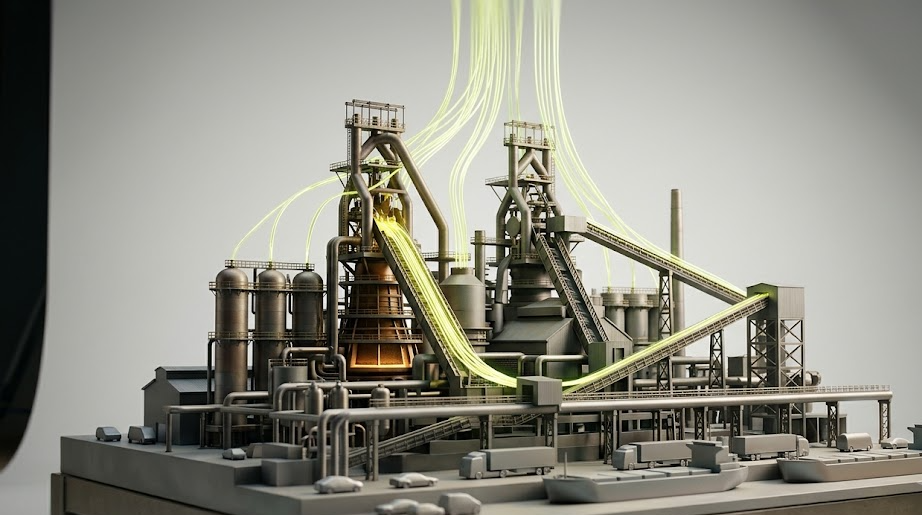
The key concept is transition finance. It refers to finance that supplies the money needed for carbon-intensive sectors such as steel, petrochemicals, cement, power generation and automobiles to switch to low-carbon processes. Its targets differ from those of green finance, which funds eco-friendly projects. Korea established the Korean green taxonomy (K-Taxonomy) in 2021 and has channeled funds through green bonds and other instruments.
The Korean transition finance policy guidelines released in February 2026 were drawn up to use EU-style taxonomy standards together with Japanese-style review of corporate transition strategies. Where and how the two approaches connect, and the detailed rules for determination, have not been issued. At a point when the United States has pulled back on related policy and the EU has turned to regulatory simplification, Korea is proceeding with institutional design.
Implementation on the ground is also moving. NH Nonghyup Financial Group said on June 16 that it had carried out three transition finance deals worth 12.2 billion won in agriculture, agrifood and advanced semiconductor industries. In April it began work with an outside consulting firm to upgrade its transition finance strategy and operating system, and it selected these deals after combing through more than 30 candidates. Whether these three deals passed the recognition standards of the February guidelines has not been confirmed.
Links between guarantee institutions and regional banks have also appeared. The Korea Credit Guarantee Fund and Kwangju Bank signed an agreement on activating non-face-to-face and digital finance and an agreement on supporting K-Taxonomy conformity assessment, respectively, on June 15. Kwangju Bank handles green loan classification and preferential rates, and the Korea Credit Guarantee Fund provides the conformity review documents that serve as the basis for those determinations. The two institutions also decided to launch a "bank-linked Easy-One guarantee" in the second half of the year.
The next point to watch is the K-GX strategy at the end of July. If the outlines of tax and regulatory support emerge there, it will be possible to gauge what will go into the promotion act. The base year for the 790 trillion won and its annual allocation, and whether implementation cases extending to agriculture and semiconductors fall within the definition of transition finance, are matters to be examined at the same time.