The 2026 World Heritage Festival-Gaya Tumuli opened on August 28 in Haman, South Gyeongsang Province. It is the first event to connect the seven Gaya tomb clusters on a single stage since their inscription on the UNESCO World Heritage List. The attempt to call scattered ridgelines by one name began in the third summer since the inscription.
The Gaya Tumuli were added to the World Heritage List in September 2023. What was listed is a single heritage site, but its body is scattered across several places. The serial property format looks tidy on a map, but on the ground it splits into different administrative boundaries, different budgets and different management staff.
What this festival tests, then, is whether the seven tomb clusters can actually be linked. The event that opened in Haman runs through September 10. Bodies involved in World Heritage matters, including the Korea Heritage Service, are taking part together.
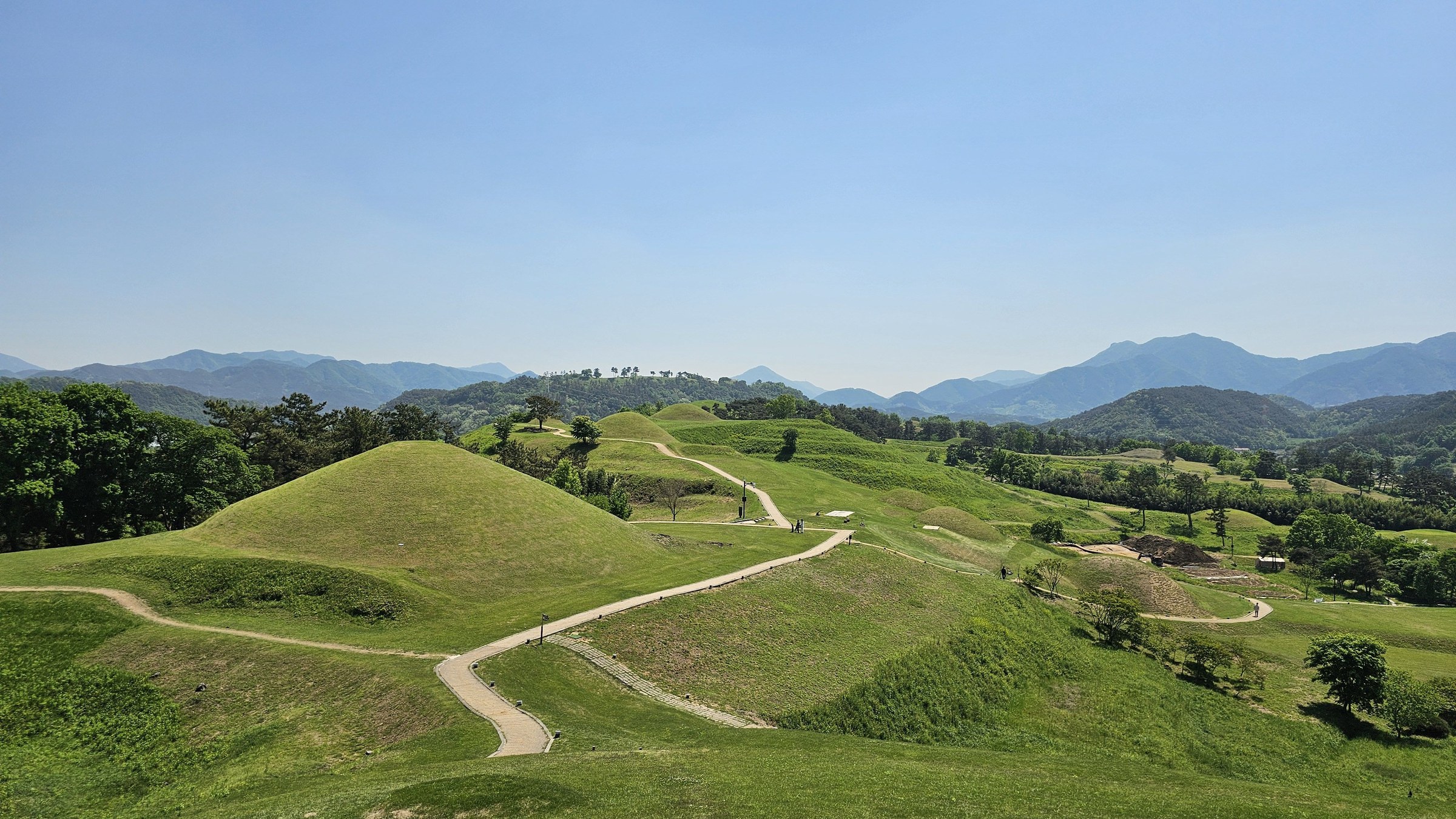
A burial mound is not an object you can hold. A hemisphere raised from packed earth, a surface covered in grass, ground that gives way softly underfoot after rain. It does not stand tall like a fortress wall and cannot be looked up at like a pagoda, so the tomb clusters have always been heritage that requires an explanation of "what you are going to see." That is why the festival lays lighting and sound over the ridgelines.
Related events came out in other regions the same week. The Daeseong-dong Tombs Museum in Gimhae announced on August 27 that it will run an education program in September to mark the third anniversary of the inscription. The program is called "Making a 3D Puzzle of the Daeseong-dong Tombs." It has participants stand flat pieces upright to build the volume of a burial mound with their hands.
Goryeong County held a night tour of the Jisan-dong Tombs. On September 5, the third anniversary of the inscription, a Daegaya nakhwa fire play is scheduled in the Ureukji area. During the night tour period, a flea market and food area operate at the "Daega Night Market," along with a program that verifies receipts spent within the county.
Here the texture of the connection diverges. There is a fine gap between the declaration of a single stage and the reality of each local government opening its own night. It is not clearly shown whether the individual events are official parts of the integrated festival or their own planning. Whether the word alliance is the name of an organization or a way of addressing one another is also loose at this point.
That looseness is not necessarily a flaw. Protecting the ridgelines and drawing people in have always moved at odds with each other. As night lighting and foot traffic increase, damage starts from the grass surface and the drainage, and once the earth of a mound collapses it cannot be restored. The distance between the sparks of the nakhwa fire play and the burial mounds is an item that must keep being calculated after the festival ends.
Besides the Gaya Tumuli, South Gyeongsang Province is home to the World Heritage sites of Tongdosa Temple in Yangsan, Namgye Seowon in Hamyang, and the Printing Woodblocks of the Tripitaka Koreana and Miscellaneous Buddhist Scriptures at Haeinsa Temple in Hapcheon. If the mountain temple, the seowon and the woodblocks are each heritage rooted in one place, the tomb clusters are heritage with their body divided across many places. It is not solved by one region doing well. All seven must hold up to the same standard to remain on the list.
On the evening of September 5, fire will fall at Ureukji in Goryeong. A few days before that, children in Gimhae will be standing paper pieces upright to build burial mounds, and the final week of the festival remains on the ridgelines of Haman. Covering all three places in one day is too much, but splitting a single weekend between Haman and Goryeong lets you see both the color of the earth by day and the lights by night. Wear low shoes, and on the day after rain it is better to avoid the paths inside the ridgeline.