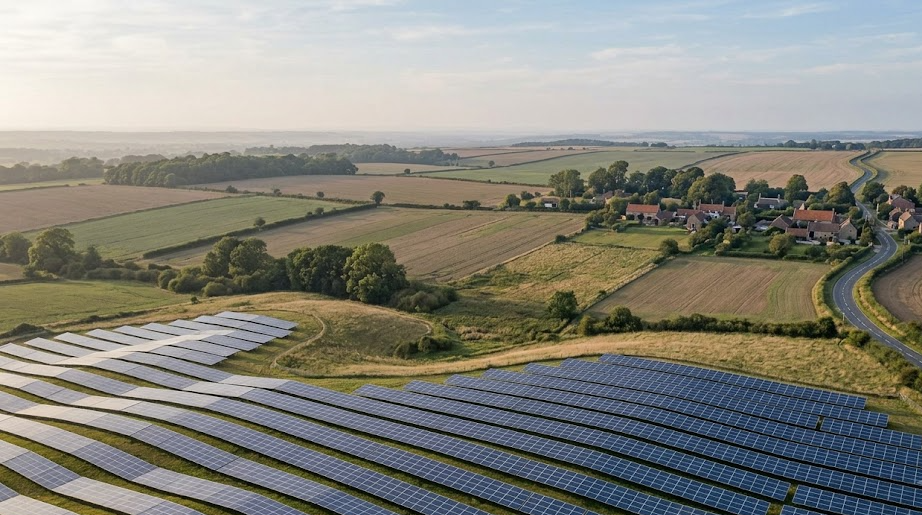
200 meters from residential areas, 100 meters from roads. The upper limit on setback distances for solar power facilities that local governments may set by ordinance has been written into the text of an enforcement decree for the first time. It is contained in the amendments to the enforcement decree and enforcement rules of the Act on the Promotion of the Development, Use and Deployment of Renewable Energy, which the Ministry of Climate, Energy and Environment announced for public comment on the 29th of last month. The comment period runs until July 8.
Until now, setback distances differed from one local government to another. Some set 100 meters, others set distances far greater than that, and the difference decided whether a project was possible at all. Specifying the upper limit in law comes closer to meaning that discretion based on local circumstances is recognized while the state draws the outer boundary of that discretion.
A different standard was applied to wind power. It limits the distance to within a maximum of 1,000 meters from homes and roads, and at the same time stipulates that the minimum distance must be at least twice the height of the generating facility. Both the upper and lower ends were set together. For tourist sites, tourist complexes and natural settlement districts, the head of the local government was left free to decide whether setback distances apply.
This amendment is a follow-up step to the parent act revised last March. With 'new energy' dropped from the law's title, the names of the enforcement decree and enforcement rules change accordingly, and the phrase 'new and renewable energy' throughout the provisions is all revised to 'renewable energy.' Provisions on hydrogen energy, fuel cells and coal liquefaction and gasification are deleted or moved into the framework of the Act on the Promotion of the Hydrogen Economy and Hydrogen Safety Management. Having hydrogen energy facilities and fuel cell generation counted separately in the criteria for designating RPS supply obligors and in calculating mandatory supply volumes is part of the same cleanup.
Of the 100 GW of renewable energy the government has set for 2030, solar power's share is put at 87 GW. To fill that scale, which sites are selected matters more than securing land on a large scale. It means the distance from villages, the distance from roads, and the ecological value the land holds have to be calculated together on a single screen.
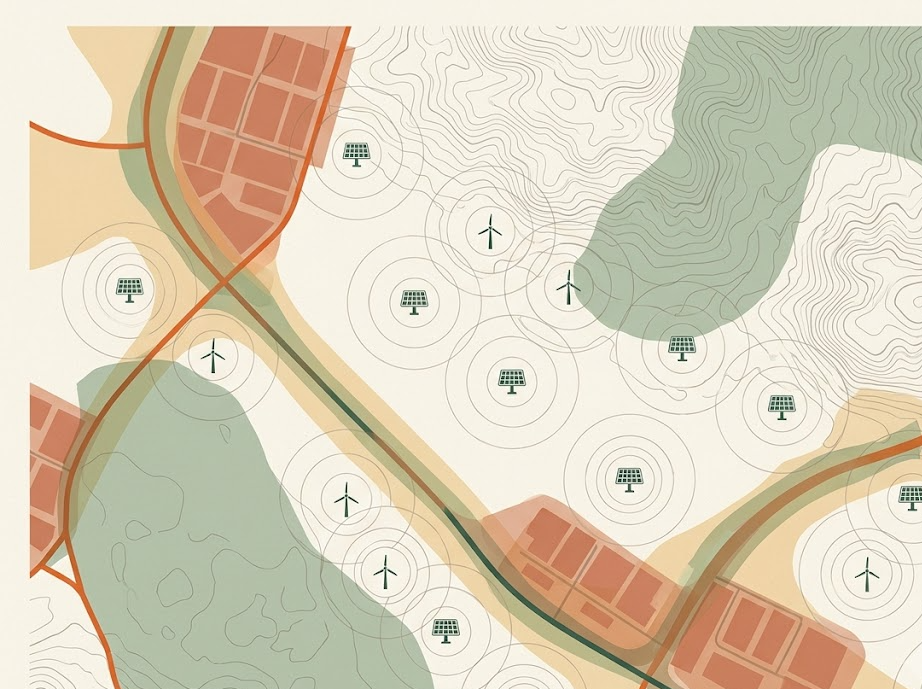
Developments on the technology side point the same way. The Korea Environment Institute held an environment forum on the 28th of last month under the theme 'Climate and Environment Policy Innovation Led by AI.' The venue was the Korea Press Center in Jung-gu, Seoul. The integrated climate policy knowledge graph introduced at the forum is an effort to weave environmental laws and policies, projects, research materials and environmental indicators into a single ontology, and it is currently under construction.
The same presentation also frankly showed the limits of AI. In air quality forecasting, the value one hour ahead nearly matched observations, but reliability fell sharply three days out. It means the forecasts are more accurate than people over short spans and waver over long ones. That is also why they are of great use in areas that handle accumulated spatial data, such as identifying sites.
Automation is under way in the field as well. H Energy (에이치에너지) automates the drafting of solar plant design drawings and the generation of permit documents with its AI agent 'Helios Mastery.' It also uses the 'SolarOnCare Index,' which assesses a plant's condition by combining generation output, component aging and maintenance history. As repetitive work at the design stage decreases, the time left over can be turned to examining sites more closely.
At 'Mohat Power Plant No. 2089' in Namdong-gu, Incheon, a safety manager checks generation data and the condition of inverters and support frames. Such inspections remain a task that an algorithm on a screen cannot take over. A design that solves expansion and conservation together ultimately means a state in which remote analysis and on-site hands complement each other.
The figures in the draft notice are not final. The lines of 200 meters, 100 meters and 1,000 meters may be adjusted after the comments that come in by July 8. Whether a resident living near a solar site or a building owner weighing whether to put panels on a roof, anyone can submit an opinion during this period through the Public Participation Legislation Center. That is how the lines that decide where and how to build get drawn.