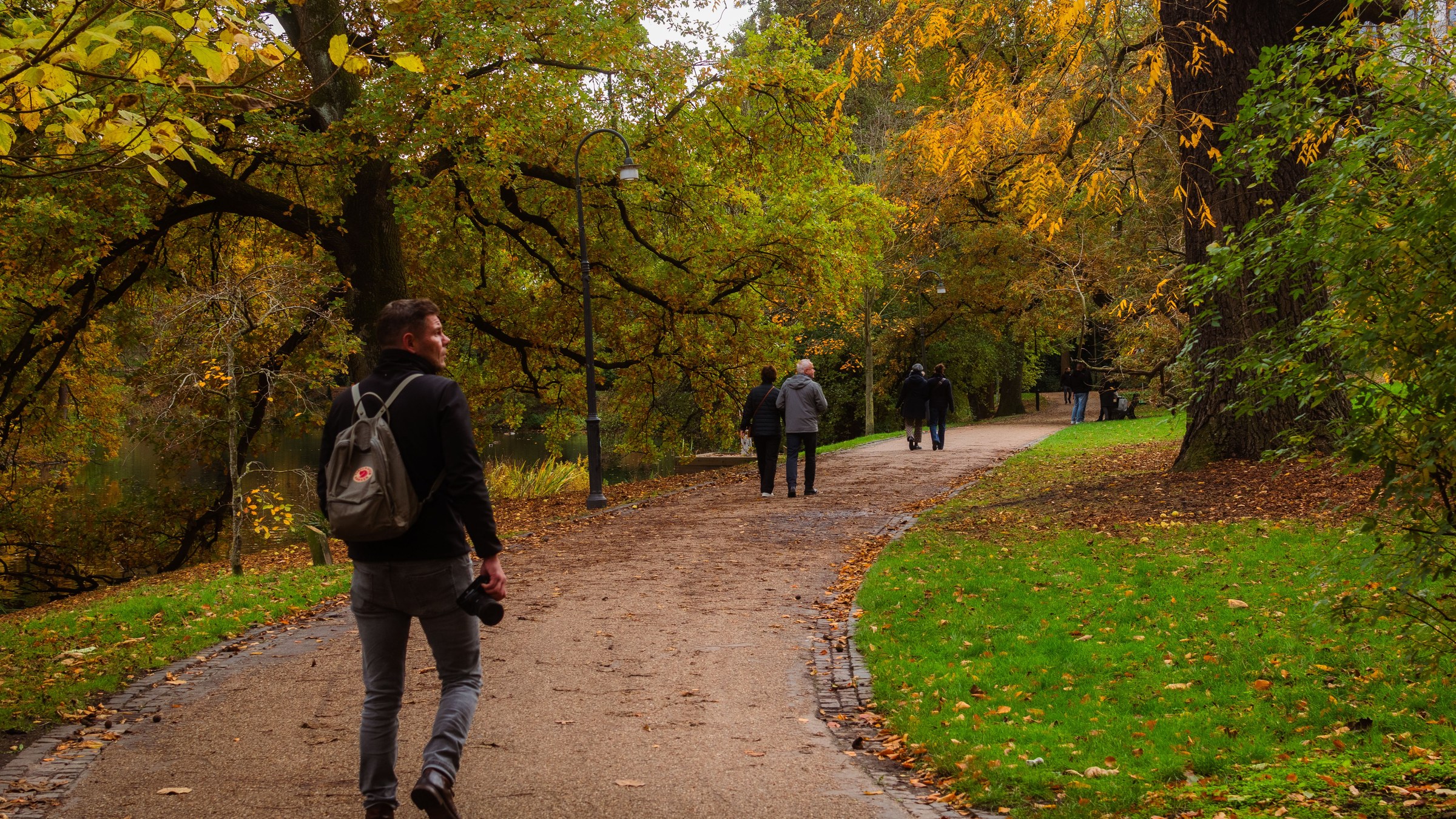
Under a clouded sky, a park path curves gently. While the yellowed leaves hold on at the tips of the branches, fallen leaves lie in a thin layer over the wet dirt path. A man with a camera walks with his head turned toward the lake on the left, and some distance away two people go along shoulder to shoulder. Farther off, at the end of the bend, there are two more people.
The place where the eye lingers longest in the photograph is the pair walking ahead. The one in the light outer jacket is slightly behind, and the one in dark clothing is half a step in front. The gap between them neither widens nor closes. One of them is probably walking more slowly than usual, and one of them is probably walking with a little more effort than usual.
To walk together does not only mean being on the same path. It means a state in which the faster person slows down and the slower person does not have to feel sorry. Care, education, and the workplace all come back in the end to this question of adjusting one's stride. Matching each other's steps has always been harder than widening the path.
The path in the photograph splits once on the right. There are people on the branching path too, and that path is narrower than the one before it. Whichever path one takes, the wet leaves are slippery, and especially so under the feet of someone walking alone.
Looking at the photograph again, there is quite a long distance between the man walking up from behind and the two people ahead. That distance may close, or it may remain as it is. What decides it is not the path but the people walking.