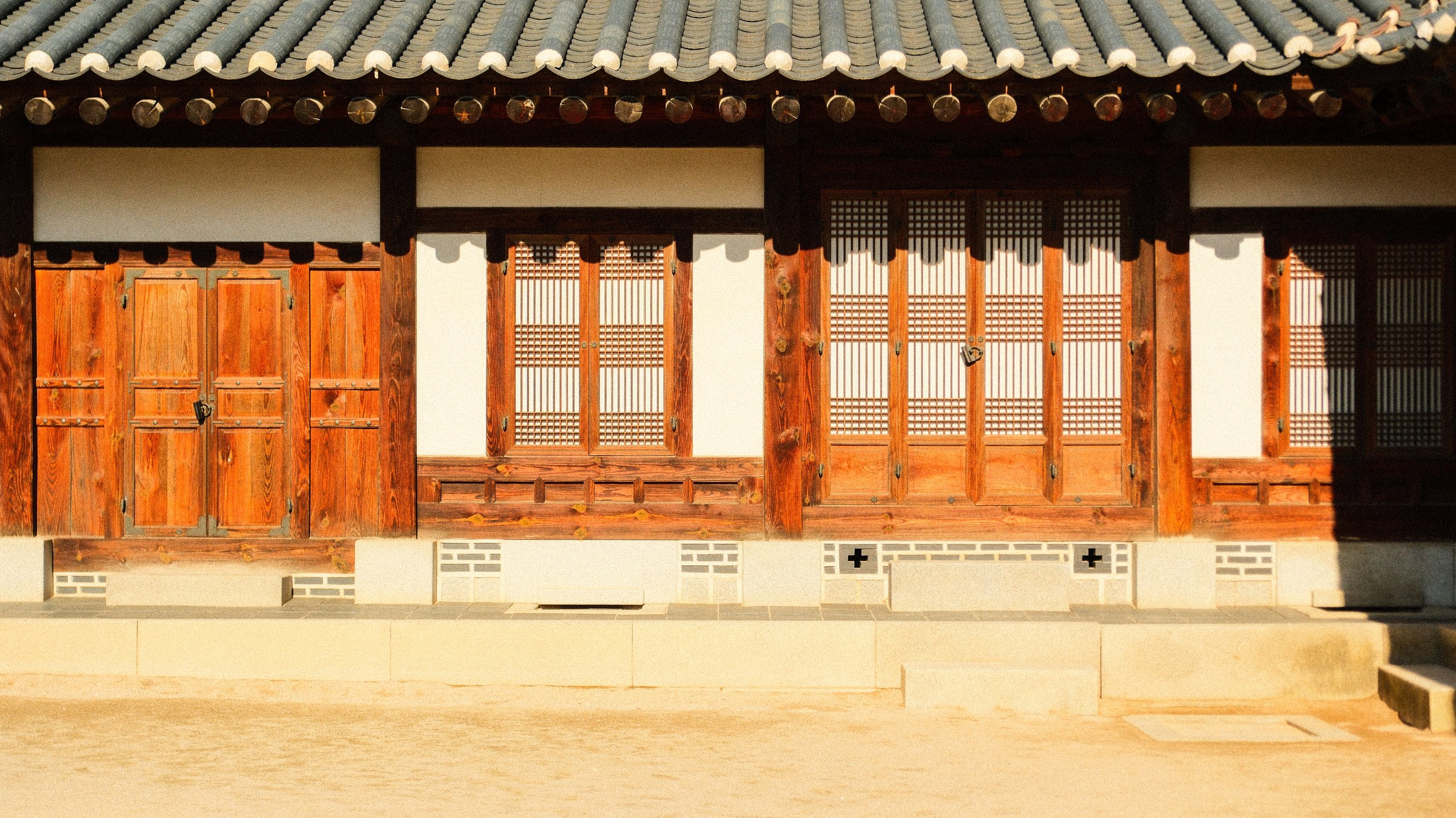
The sun tilts low and pushes the wood up into red. The gray-blue of the roof tiles still remains on the shaded side, and below it only the window lattices and the plank door take on the warm color. The white wall throws the light back, and it spreads faintly as far as the yard.
The doors are all closed. On the left, the plank door stands with thick boards set vertically, hiding the inside completely, while the center and right windows are woven with fine, closely set slats that divide inside from outside only halfway. In the same house, some doors block and some doors filter.
An old door is a tool for coming and going and at the same time a record of time. Wherever the grain has cracked and the color has faded, the height a hand once reached remains, and below, the stepping stone and the base platform hold on to the spot where feet used to stop. Even with no one in sight, the measurements of people remain.
The yard is empty. The earth has been swept smooth, without a single footprint, and that blank space instead pushes the eye toward the doors. The emptiness feels like an old form of courtesy in this house.
The red light breaks off about midway up the wall. Above that line the white plaster wall still holds the color of day, and below it a blue shade spreads along the base platform and has climbed as far as the threshold. The difference in the lattices that separated blocking from filtering also blurs as it crosses that boundary. Whether a door blocks or filters, from the side the light has withdrawn they all take on the same darkness.
Before long the light will pass beyond the lattices and withdraw under the eaves. Then the wood that was red will darken again, and the doors will still be closed. What the closed doors were keeping is worth another look at the photograph.