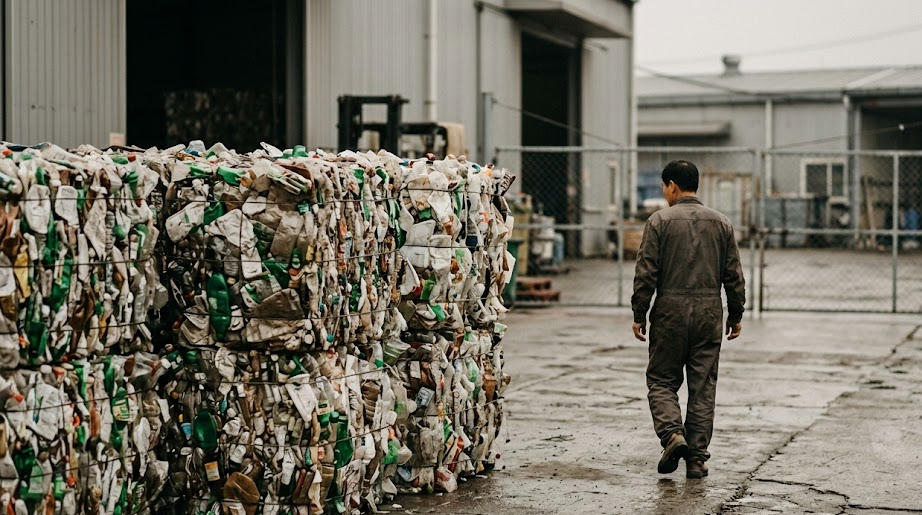

One disposable cup weighs 20g. If 50 million people cut one such cup every day, a tenth of the 3.83 million tons of waste plastic coming out of households as of 2023 would disappear, the Ministry of Climate, Energy and Environment estimated. On the basis of this arithmetic, a nationwide plastic reduction campaign joined by 3,437 "disposable-reducing shops" across the country began on the 13th. It takes the form of an action pledge and runs for six months.
Behind it is the war in the Middle East. With supply of oil and naphtha, the raw materials for plastic, shaken, reduction has become a raw-material security agenda as well as an environmental one. Kim Sung-hwan, Minister of Climate, Energy and Environment, announcing at the Government Complex Seoul on the 24th of last month that the public should take part in energy-saving actions including the no-driving-day system for passenger cars, stands on the same current. A statement was also issued today on the "plastic-free economy" ordered by the president.
The campaign's content is not difficult. It is built around nine action rules including using a tumbler, bringing a shopping bag, and using reusable delivery containers. If you pledge to the rules on the online resource circulation action platform run by the Korea Environment Corporation and post photos verifying your practice, you also receive prizes every month.
The problem lies in the fact that the side said to have joined hands does not know it. "Disposable-reducing shops" are cafes, restaurants, and group meal facilities that voluntarily take part in using tumblers and refusing disposable utensils and straws, and the program has run since July 2021. Among them, only those that pass an unannounced on-site evaluation are separately designated as "disposable-reduced shops," and there are just 17 in the entire country.
The owner of "1.5 Degrees," a zero-waste shop in Seoul and one of those 17, said she had received no notification about this cooperation. "Nangman Jigu," the only one in South Jeolla Province, was the same. The two owners said this was not a matter of this case alone, and that even in normal times there had been no encouragement to participate, no delivery of basic information, and no support for spreading the program in the region.
If the shops that have practiced this longest are learning of the campaign through the press, whether the message reached the remaining 3,400 or so shops also needs to be checked. The ministry's explanation of how the notice was given has not been organized. It is a gap that commonly appears when a registration list and the actual communication channels run separately.
Six months is not short. If, while pledges and verification posts accumulate, support for participating shops and a way of measuring results are designed together, the campaign can move toward being a response to raw-material supply. Conversely, if it stops at counting the people who pledged, the same work will have to start over from the beginning six months later.
Pledging on the resource circulation action platform takes only a few minutes. And if the shop you walked into to buy coffee today has a "disposable-reducing shop" sticker on it, asking whether they have heard about the campaign is one approach. That brief conversation may be faster than the government's delivery system.