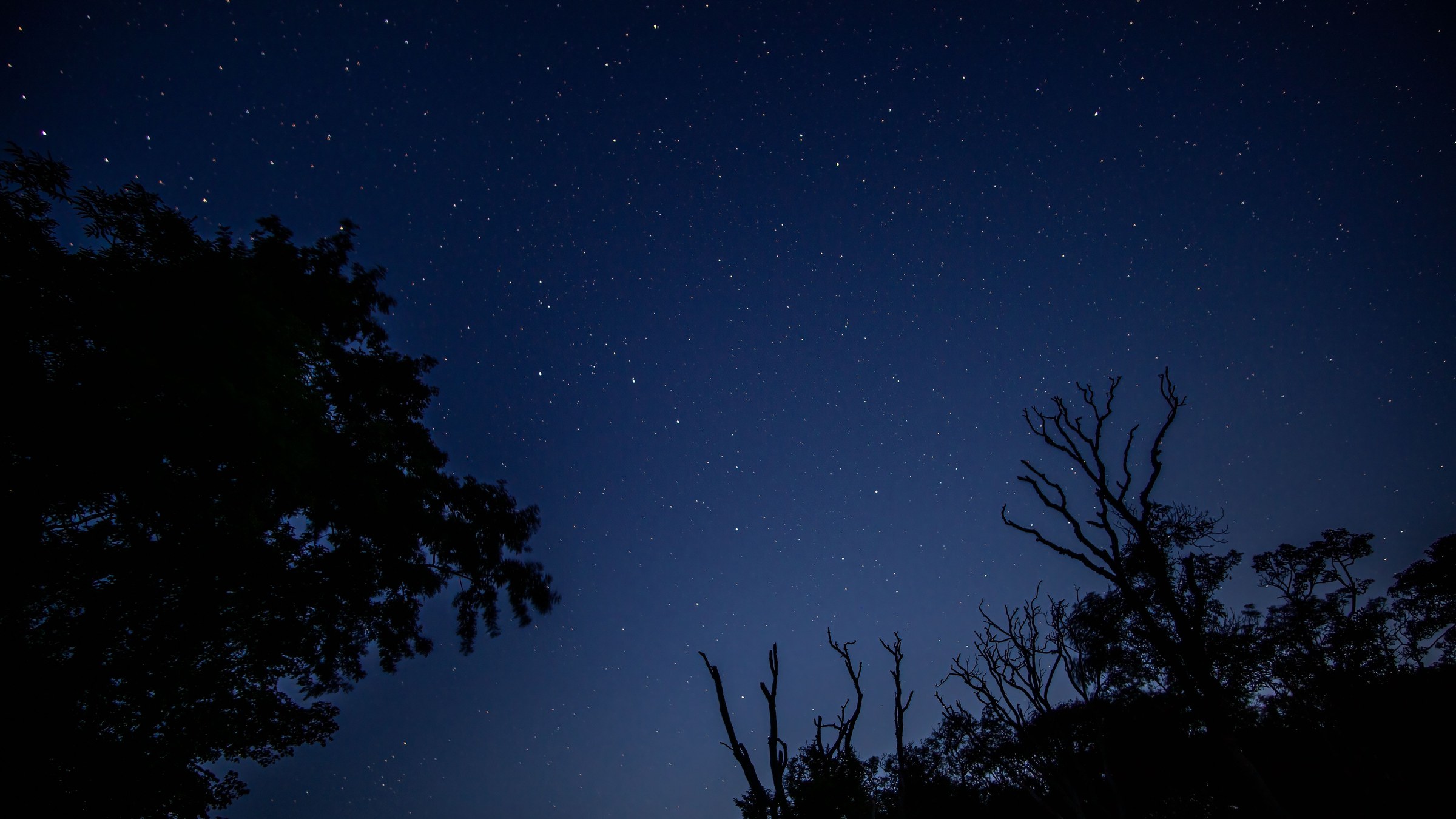
Small stars are scattered across a deep navy sky. On the left is the black mass of a tree in full leaf, and on the right, branches that have dropped all their leaves stretch out like fingers. Only the part near the horizon is faintly bright, and the color deepens toward the top. It is an hour that no lamplight reaches.
To see a sky like this you have to tilt your head back. When the chin lifts, the tightened front of the neck opens, and the breath you draw in grows a little longer than usual. The eyes find nothing to settle on and wander through the darkness. The soles of the feet press the frozen ground, and both hands warm slowly inside the pockets.
When a gaze that has been turned downward all day opens upward, the tasks that need urgent handling step back for a moment. The hurry does not disappear, it is only that the sound turns down for a while.
Open a window, or take three steps outside the door and look up at the sky for about thirty seconds. It does not matter if no stars are visible. How about just watching how the breath changes while your head is tilted back.
The same thirty seconds can also find room while you wait for the elevator at the entrance after coming back from a night walk. You could close your eyes for a moment from following the floor indicator and feel with the back of your hand how the belly swells and falls under your coat. The hem of the coat, cooled outside, may dull the movement so that it is hard to catch. If you cannot catch it, watch it as it is, and when the door opens you can stop.
The star caught on the tip of a branch is never visible to someone looking down.