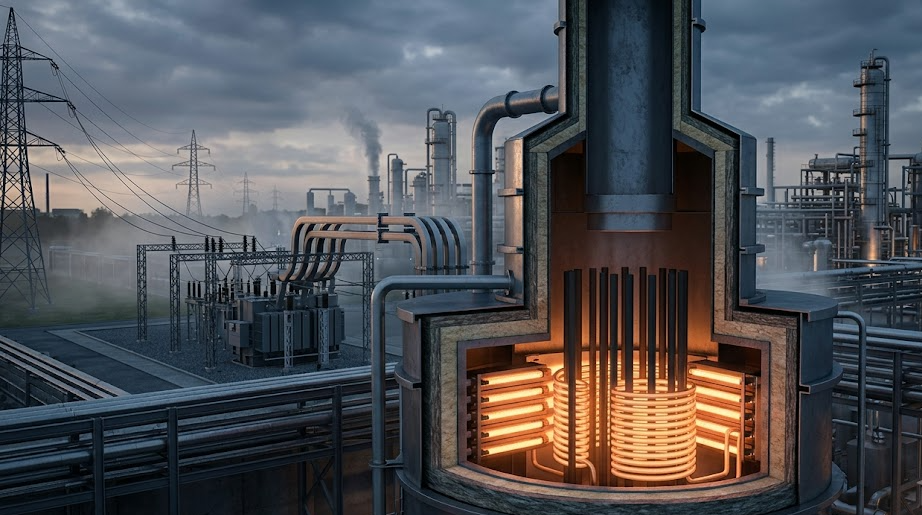
A plan to convert petrochemical naphtha cracking centers (NCC) to run on electricity was taken up as a common agenda item at two forums held at the National Assembly Members' Office Building on the 16th and 17th. Kim A-young, a researcher on the petrochemicals team at Solutions for Our Climate (기후솔루션), said in her presentation on the 17th that the NCC process accounts for about 70% of greenhouse gas emissions from petrochemical processes. The same presentation offered an analysis that NCC electrification is more effective in cost terms than switching fuel to hydrogen. On the other hand, the conditions put forward by industry regarding the scale of electricity required and the burden of rates still differed.
The forum on the 16th was hosted by Rep. Suh Wang-jin of the Rebuilding Korea Party under the theme "Decarbonization of the Industrial Sector, Electrification Strategy and Institutional Design," in Conference Room 5 of the National Assembly Members' Office Building. Rep. Suh said the industrial sector is the largest source of emissions, accounting for about 41% of the country's total greenhouse gas emissions. He added that the industrial sector's reduction rate over the six years since 2018 came to only 4.5%. The reduction rate for the power conversion sector over the same period was given as about 22.9%, and for both figures the base year was not stated in the remarks.
Kwon Pil-seok, head of the Green Energy Strategy Institute, who delivered the keynote presentation, assessed that industrial decarbonization in Korea is at an early stage and that data-based policy infrastructure is lacking. The steel and petrochemical industries agreed on the need for process conversion including electrification, while pointing to the burden of electricity costs, large-scale power demand and the investment burden of converting facilities as obstacles. Nam Jung-im, head of the technology and environment office at the Korea Iron and Steel Association, said industrial electricity rates have risen more than 70% over the past three years. The calculation period and the type of rate plan were not specified in the remarks.
The following day, in the same conference room, the "Forum on Decarbonization Strategy to Overcome the Regional Crisis in Petrochemicals," co-hosted by the National Assembly Climate Crisis Decarbonized Economy Forum and Solutions for Our Climate, was held. Yoon Je-yong, a professor at Seoul National University, chaired the session, and some 50 people from industry and expert circles attended. At the forum, the petrochemical industry said electricity rates had more than doubled. The 70% cited by the steel side the previous day covers a different calculation period and subject, so the two figures are hard to compare directly.
Kim also pointed to regional dependence. Petrochemicals account for 29.5% of gross regional domestic product in manufacturing in South Jeolla Province and 26.5% in South Chungcheong Province, and at the Daesan complex in Seosan, South Chungcheong, 81.4% of manufacturing shipments come from petrochemicals. A scenario was presented in which some processes such as heat pumps are at the commercialization stage and can be applied before 2030, with NCC electrification introduced in earnest from 2035. There was also an assessment that BASF, SABIC and others abroad are operating large-scale demonstration facilities, while Korea remains at the stage of small-scale technology development.

Park Jin-soo, CEO of Plan It, said in a presentation analyzing investment costs by decarbonization technology that NCC electrification is a more realistic alternative than hydrogen conversion and called for risk sharing between the government and companies. Along with an assessment that electricity-based NCC is ahead of hydrogen-based processes in technological maturity and timing of adoption, he also offered the view that an electricity-based transition after the mid-2030s is a realistic scenario. For institutional design, he proposed introducing a Korean-style carbon contracts for difference scheme (K-CCfD) drawing on the German case.
The response from companies was conditional. Jang Yong-hee, head of LG Chem's low-carbon promotion team, estimated that up to about 1GW of electricity would be required for an NCC of one million tons. His explanation was that verification of material durability and long-term operating stability in ultra-high-temperature environments remains, and that the entire process must be redesigned, including treatment of by-product gases and rebalancing of heat. Kim Dong-ha, a team head at HD Hyundai Chemical, said the business would be difficult to pursue unless economic viability is secured, and called for the introduction of shale gas-based feedstock, demonstration of co-feeding at existing facilities, and infrastructure and government funding support.
Korea's petrochemical industry, centered on the three main bases of Yeosu, Ulsan and Daesan, has the world's fourth-largest production capacity after China, the United States and Saudi Arabia. Output was 111 trillion won in 2023, and exports were $48 billion in 2024. At the same time, the sector emits 53.6 million tons, or 18.8% of industrial-sector greenhouse gas emissions, the second-largest share after steel. Civic groups, the government and academia shared the recognition that the EU Carbon Border Adjustment Mechanism (CBAM) will begin imposing an obligation to purchase carbon certificates in earnest from 2026 and that legislation on the US Clean Competition Act (CCA) is under way.
Panelists at the forum on the 17th included Choi Jung-yoon, a legislative researcher at the National Assembly Research Service, and Yoon Woo-sook, a team head in the future industry division of the South Chungcheong provincial government, along with Lim Ho-soon, director of the decarbonization and green industry innovation division at the Ministry of Climate, Energy and Environment, and Park Jung-hee, an official in the chemical industry division of the Ministry of Trade and Industry. Kim argued that NCC electrification should be included among the core strategic technologies of the special act on petrochemicals. Rep. Park Jung-hyun of the Democratic Party of Korea, in congratulatory remarks, presented the streamlining of production facilities through the government-approved "Daesan Project No. 1" and a reduction in the share of NCC-centered commodity products.
In the two days of discussion, no side denied the need for electrification itself. What divided them was at what price, by when and at whose expense the electricity would be secured. The estimate of 1GW per million tons and the rate increase of 70% over three years were presented in the same conference room, but no calculation standard for weighing the two indicators together has been disclosed. Whether the special act designates it as a strategic technology becomes the next point to watch.