Nine out of ten workers in the industrial robot and secondary battery industries felt anxious that automation could cut their jobs or push them into other work. That is the finding contained in the "Survey on Measures to Promote Labor Rights in Response to New Hazards and Risks Arising from Industrial Restructuring," released by the National Human Rights Commission of Korea on the 16th. The survey is based on a questionnaire the Korea Contingent Workers' Center put to 500 workers in the two industries last year. Only 9.6% said they felt no anxiety at all.
The 90% total is the sum of answers of differing intensity. "Sometimes" was the most common at 32.0%, followed by "rarely" at 24.8%, "often" at 23.2% and "very often" at 10.4%. Taking out only "often" and "very often," which can be read as constant anxiety, the figure is 33.6%. The one-third under daily pressure and the remaining half who have the thought cross their minds now and then together make up the 90%, so the number needs to be read with care.
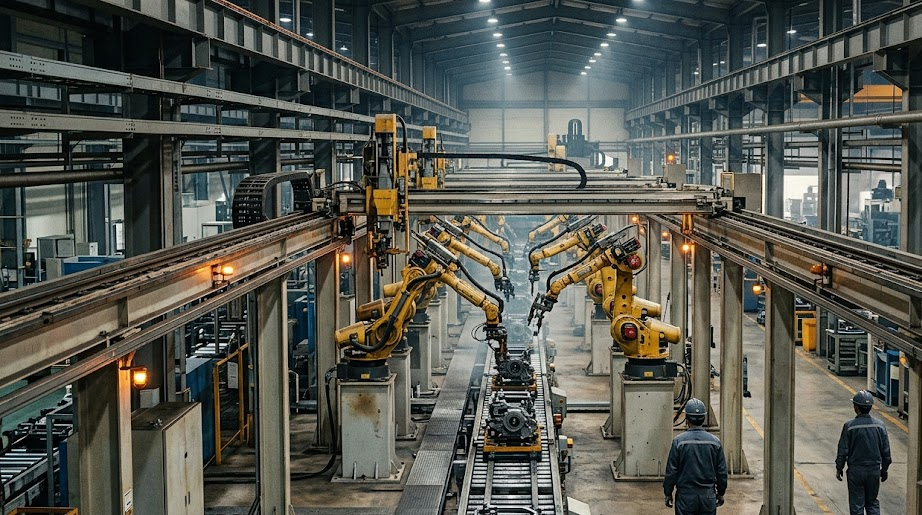
The anxiety was not merely vague. Some 62% of respondents said they were experiencing robots coming into their processes firsthand. Adoption in some processes came to 46.0%, in most processes 13.2% and in all processes 2.8%, while 11.2% said there had been little change. By workplace size, automation of some processes stood at 49.1% at workplaces with 500 or more workers, 44.0% at those with 100-300 and 43.8% at those with 300-500, spreading more widely the larger the workplace.
An interesting point is that the extent of adoption and how it is felt do not move in the same direction. In group averages measured on a five-point scale, workplaces with 100-300 workers recorded 3.3 points for lack of training and 3.5 points for job insecurity, and workplaces with 300-500 workers recorded 3.3 and 3.4, above the overall average of 3.0. By contrast, workplaces with 500 or more workers, which have brought in the most robots, were lowest at 2.7 points for lack of training and 2.5 points for job insecurity. Large companies are ahead in equipment investment, but the pressure reads as falling more heavily on workers at mid-sized workplaces.
Safety problems also emerged in the same survey. Of 250 manufacturing workers who handle industrial robots, 88% said they felt a risk of collision or entrapment when working next to robots, and 61.2% said they had actually been through a dangerous situation. Those who said the noise and vibration produced when robots are running had increased their fatigue or musculoskeletal strain reached 84%.
The report also included the finding that many workers said they had trouble trusting safety devices such as emergency stop buttons. The research team called for safety standards suited to robot processes, along with transition training and job reassignment.
Training is confirmed in a separate item as well. Workers who felt they were not receiving enough training to handle new equipment came to 90.8%. In detail, "sometimes" was 37.2%, "rarely" 22.8%, "often" 20.0% and "very often" 10.8%, while 9.2% said they had never felt that way. A situation in which the equipment arrives while the way to handle it is learned on the body is close to the substance of the anxiety.
Projections for the scale of jobs came out as well. In its report "Advance Assessment of Employment Impact 2025: AI and Digital Transformation," the Korea Institute for Industrial Economics and Trade examined employment changes in 24 industries through 2030 and estimated that about 100,000 workers in major industries could be replaced by AI. General retail is estimated to fall by 40,000, from the 230,000 range to around 190,000, and software development by 30,000, from 450,000 to 420,000, while land passenger transport falls from 235,000 to 215,000 and telecommunications by around 10,000. Gil Eun-sun, head of the Population Strategy Research Division at the Korea Institute for Industrial Economics and Trade, explained that the analysis assumed employment would adjust gradually, without mass layoffs or abrupt workforce cuts.
Before taking the replacement projections at face value, research on the other side is worth a look. "AI and Jobs: Evidence from Online Vacancies," by professors Acemoglu and Autor, reported that in U.S. online job posting data from 2010-2018, demand for AI-related positions kept rising but no clear decline in overall employment was detected. The probability of hiring AI personnel in industries with large potential for AI use was about 15% higher than in other industries. In Korea, software developer jobs held by those aged 25-29 fell by nearly 10,000 over three years as of August 2025, while a report released last month by the National Assembly Budget Office found that hiring of those aged 15-29 rose in occupations such as accounting and bookkeeping clerks and customer service agents.
There is also a gap between the range where the technology can be used and the range where it actually is. An Anthropic report put the theoretical room for large language models, that is, AI trained on vast amounts of documents to produce sentences, to make inroads at 94% in computer and mathematical work and 90% in office and administrative work, but the share of actual application stayed in the 30% range. How many years it takes for that gap to narrow becomes, for workers, the length of the time they have left.
The Hyundai Motor labor union has publicly raised the employment issue tied to the introduction of AI and robots, and the standoff with the company continues. At the "2026 Smart Factory and Automation Industry Exhibition," held at COEX in Seoul on the 4th of this month, Boston Dynamics' humanoid robot "Atlas" was on display.
The anxiety arrived at the factory before the replacement actually happened, and the discussion is moving toward how the gains will be shared, through ideas such as a robot tax and a basic society. In the meantime, what can be dealt with right away is safety standards and training. Whether a person working beside a robot arm can trust the emergency stop button, and whether proper training comes with new equipment on the day it arrives rather than a half-day briefing, changes the work of that day. The 500 responses are a report on the daily lives of the people standing on the line now.