
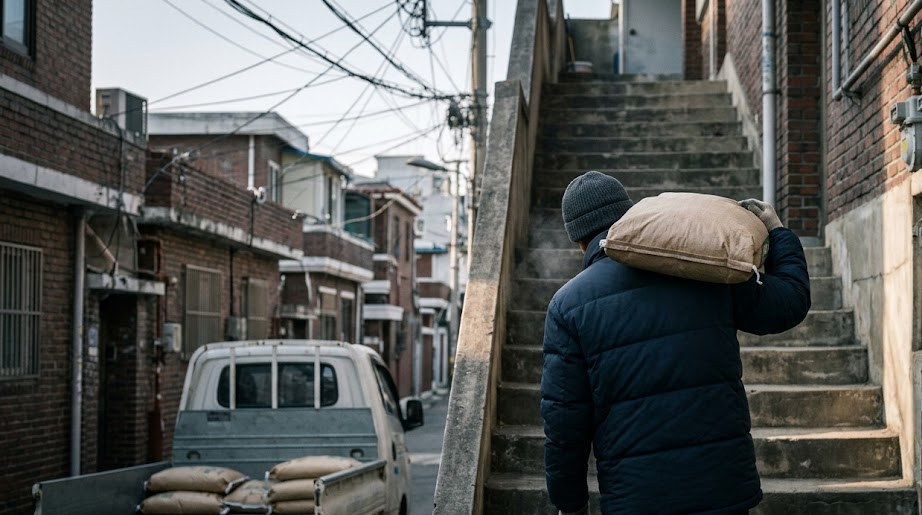
Gwangsan Delivery Co., which carries government rice across the 21 administrative dong of Gwangsan-gu, Gwangju, does not leave the goods at the door. It meets residents in person to hand over the rice, and when something looks different from usual, it notifies the dong community service center and welfare agencies. The company delivers on average to about 8,700 households a month, 12,000 bags of 10㎏ each. The delivery route has become a route for asking after people, and at a time around the Lunar New Year when the search for people falling through the cracks is concentrated, this method is sometimes faster than an administrative report.
Gwangsan Delivery Co. is a self-sufficiency enterprise founded in 2019 by two people in the near-poor bracket and one basic livelihood security recipient. It converted into a self-sufficiency enterprise in March of that year, and has since been listed for commendations from the Mayor of Gwangju Metropolitan City and the head of Gwangsan-gu Office, and as an outstanding self-sufficiency enterprise by the Ministry of Health and Welfare. It has seven employees. At that scale, local volume alone made it tight to cover wages and operating costs.
The way out came from across the sea. Since January 2025 it has widened its delivery area to Wando in Jeonnam, carrying 3,600 bags each month to 12 eup and myeon, an average of 3,070 households a month. As work running between the islands and the mainland increased, operations got some breathing room. The household figures for Gwangju and Wando are delivery records for different regions, so they are not numbers to be read together.
In Haeundae-gu, Busan, residents pin on the committee member's badge themselves. The members taking part in the community social security councils of the 18 dong number 393 in all. They held 92 meetings last year and dealt with 236 agenda items, and found 15,089 households in welfare blind spots. They also ran 144 specialized projects, one set for each dong.
Haeundae-gu has drawn up its "2026 Plan for the Operation and Support of Dong Community Social Security Councils." From this year it will increase participation by workers in trades that meet residents every day, such as convenience stores, hair salons and delivery services. It calls for capacity-building training for members and suicide prevention training, and for procedures that link people at risk of dying alone and those eligible for integrated care in advance.
In Goyang, Gyeonggi Province, cooperatives are drawing care into their line of business. The Goyang Cooperative Council held its regular general meeting on the 13th and marked the 11th anniversary of its founding. The council, led by chair Heo Seon-ju, handled 160 standing consultations, 70 consulting sessions and 13 training sessions over the year under a support program of the Gyeonggi Social Economy Center. A plaque of appreciation went to Lee Gi-dae, former chair of Dream Sharing, which was chosen as an outstanding cooperative.
The forum "Goyang Integrated Care, a Future We Make Together," hosted by the council, drew 148 people. Recently the "Goyang Social Solidarity Economy Integrated Care Task Force" was also launched. The goal the task force has set out is for social economy organizations to join hands and build a home care ecosystem. It is part of a move to hurry preparations at the local level ahead of the enforcement of the Integrated Care Support Act, though the year of enforcement is hard to state with certainty.
At the same time in Gwangmyeong, Gyeonggi Province, the Haan Community Welfare Center joined forces with six local agencies to deliver Lunar New Year support goods to 429 households. Gwangju, Busan, Goyang and Gwangmyeong differ in who does the work and in how they do it. What they have in common is that they confirm who lives where on foot instead of on paper.
There is no tally of how many households actually went on to receive support after a delivery worker sensed a crisis, or of what share of the 15,089 households Haeundae-gu found were connected to services. Indicators for gauging results remain a task still to be filled in. Even so, the change of convenience store owners and hair salon operators coming in as council members can be seen with the eye within this year. More neighborhoods are seeing the ringing of a doorbell to hand over a bag of rice become the first point of contact with the welfare system.