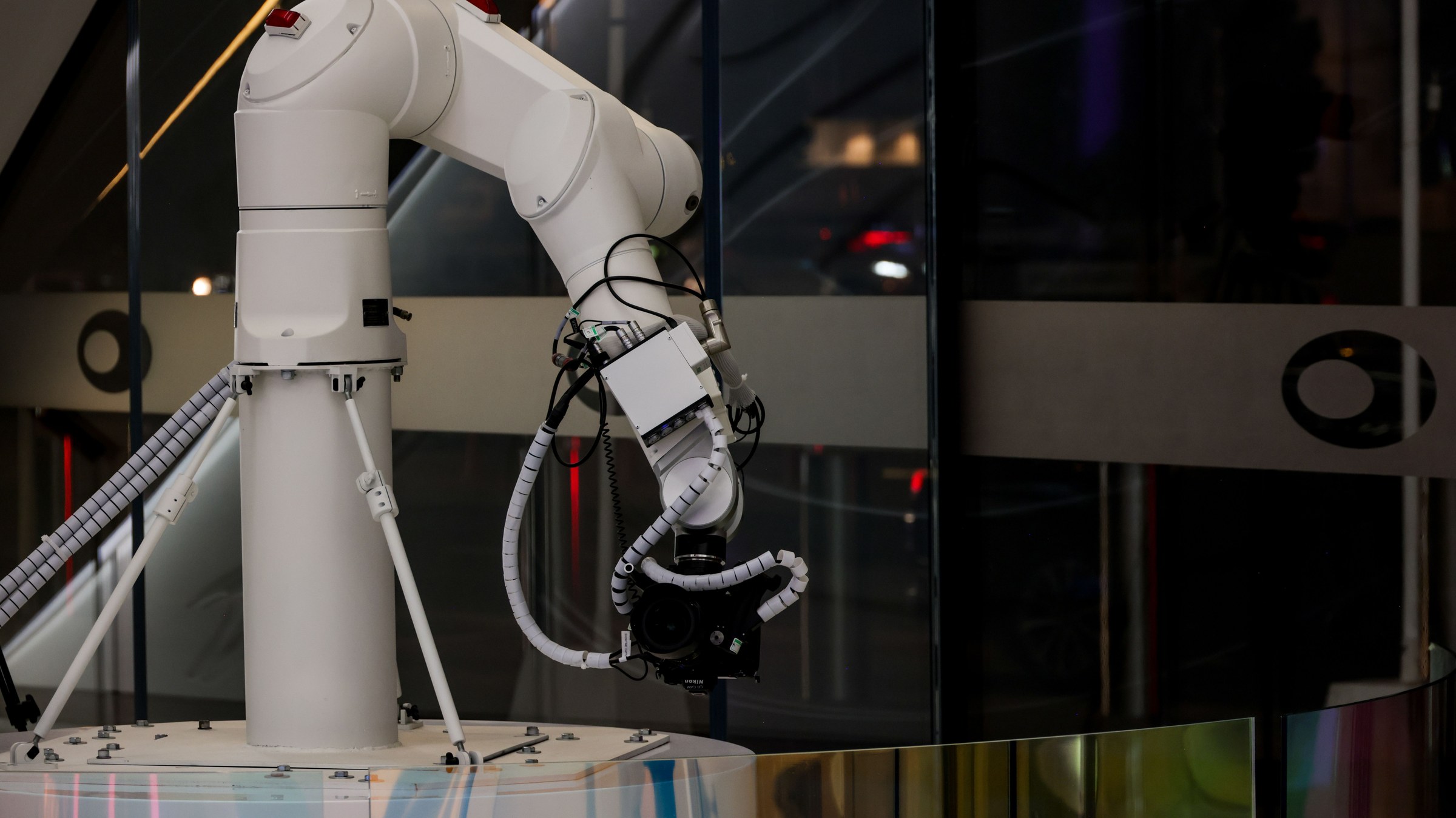
A white robotic arm stands on a cylindrical base, its head bowed forward. Each joint is finished in a smooth coat of paint, and below the wrist hang a corrugated wiring tube and black cables. The device attached at the end is the only part that is black and rough, catching the eye out of step with the white of the body.
Behind it is dark. The interior of the city is dimly reflected in a large glass wall, and a single red light bleeds through the reflection. A thin rainbow interference runs across the glass panel wrapped around the base. From the lighting and the finish, it reads at once as a stage someone arranged to be looked at, not a factory floor.
The place this arm originally lived had no windows. It is a body designed to repeat the same trajectory all day and to stop when a person is standing there. When such a body is brought up onto a display stand, the function stays the same and the audience changes.
The moment automation comes out from inside industry to the outside usually looks like this. A machine that has stopped being a machine that makes things, placed for the people who look at machines. The white paint and the soft curves are closer to clothing worn to withstand that gaze.
The floor beneath the base is smoothly ground gray, and wherever the light lands a shallow gloss rises like scales on water. Nowhere are there traces of the anti-slip stripes or yellow safety lines common in factories. The floor is saying it will not block people, and yet that arm is still a body made to stop when a person approaches. On a surface you may walk into, a machine premised on no one walking in has been placed.
Looking at the photograph again, the arm is doing nothing. It is simply frozen in the posture of the instant before grasping something. Whether that bowed angle is the staging of the exhibition or a habit worn into the body at the factory is hard to tell apart.