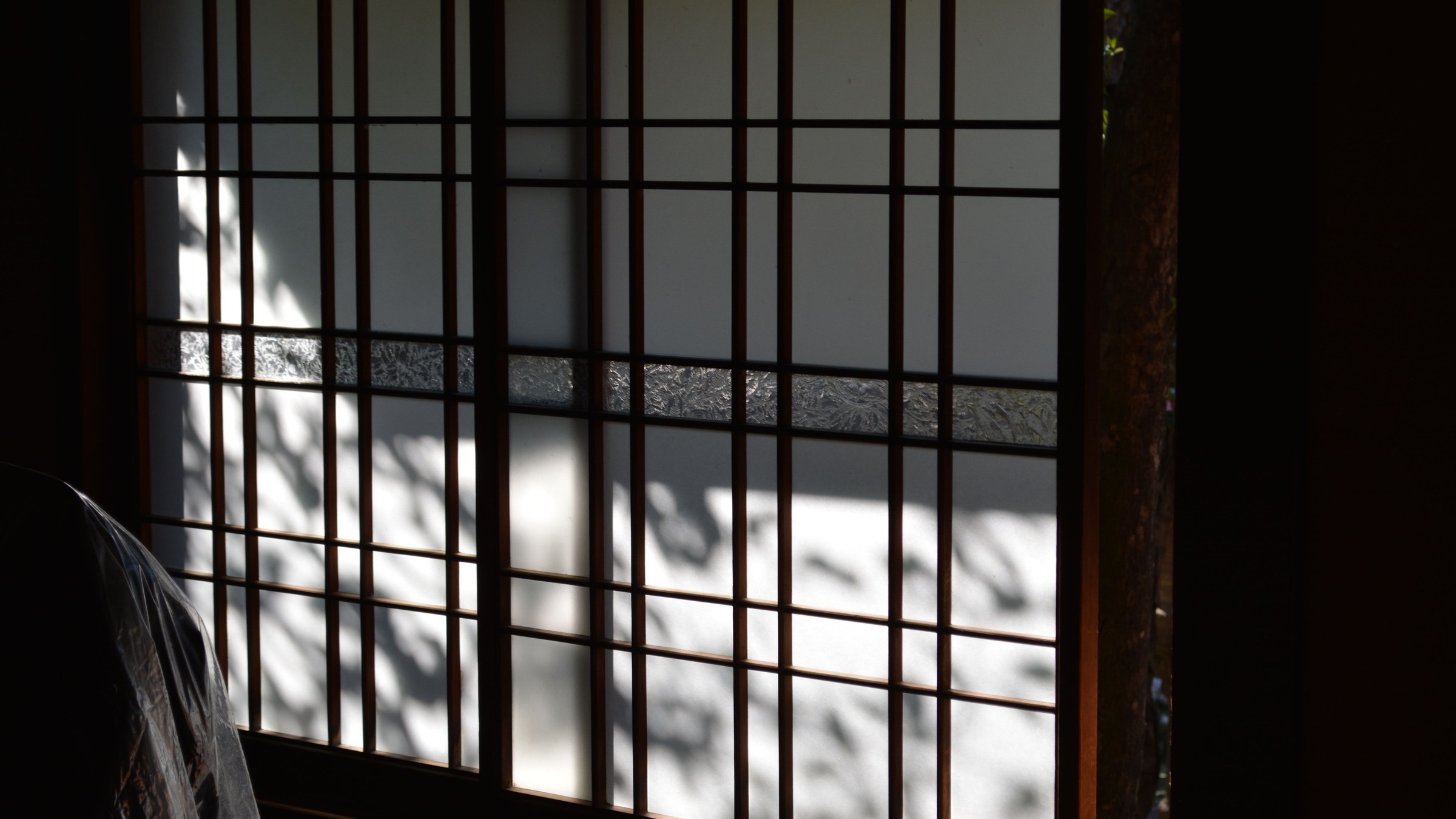
The room is nearly black. In the middle of that darkness stands a single paper window, and slender wooden bars divide the paper into many panels. A white surface floats between each pair of bars, so the whole window looks like a single lamp.
Leaves flicker on the paper. The tree outside does not touch the window directly, and only the traces the light brought with it as it passed through the leaves remain. Toward the bottom the shadows grow dense, and the upper part is empty. It is an afternoon with the sun low, the hour when light crosses the yard and reaches in under the eaves.
Only the narrow band running across the middle has a different texture. A line of glass, broken fine like ice, cuts in among the softness of the paper and lets the outside through in a blur. It neither shows everything nor hides everything.
Hanji was a material that sorted light rather than blocking it. With glass, the scenery outside would have come in as it was and taken over the room, but paper erases form and leaves only brightness. So a person sitting before the paper window sees the marks the tree has left instead of seeing the tree.
The slant of the shadows tells us the light did not come in head on. The leaves spread as if flowing at an angle from the upper left of the window to the lower right, and they lie at the same angle on each white surface between the bars. It is because the sun, coming in past the eaves, stretched out the shape of the tree. Even if paper erases form, it cannot erase the path the light traveled, and the window copies down the time outside as an angle.
This pattern does not stay long. One gust of wind scatters it, and when the sun tilts a little further it drops below the paper and disappears. Where the leaves in the photograph might be moving now, one looks at the window once more.