
It was expected that the number of workers would fall in occupations where AI does the job. What was not expected is the other side. At the 2026 Joint Conference on Economics, held on Feb. 5 at Chung-Ang University in Dongjak-gu, Seoul, Moon A-ram, head of the AI Economic Policy Group at the Korea Information Society Development Institute, presented "Artificial Intelligence and Jobs: The Need for a Labor-Friendly Response" and put forward an analysis showing that new hiring of young people aged 29 and under fell in both occupations at risk of replacement by AI and occupations that benefit from AI. It means that fewer entry-level workers were hired even on the side where productivity rose.
The trend in the figures is clear. The share of total jobs held by occupations at high risk of replacement by AI, such as accounting and bookkeeping clerks, fell 7 percentage points from 17% in September 2021 to 10% in September 2025. Over the same period, the share of benefiting occupations, where using AI raises productivity, rose 4 percentage points from 31% to 35%. Research managers, correctional officers and social workers were presented as examples of benefiting occupations.
What stands out is that the side that shrank and the side that grew do not add up. The 4 percentage points of the benefiting group did not take in all of the 7 percentage points that left the at-risk group. And within the benefiting group that grew, employment of middle-aged and older workers was stable while new hiring of young people declined. It means the people who filled the work created by the technology were not those entering the labor market for the first time.
A clue to why entry-level hiring fell even in the benefiting occupations can be found in the change in how work is divided and combined. Min Dae-hong, a research fellow at the Korea Information Society Development Institute, compared a case in which two teams split the work of summarizing product descriptions and sending persuasive emails to customers with a case in which one team handled the work from beginning to end using generative AI. When assessed on accuracy, completeness, expressiveness, logic, persuasiveness and time taken, the side that removed the division of labor performed significantly better. The sample size and specific figures of the experiment have not been disclosed.
When the division of labor disappears, what disappears is the intermediate steps. The portion handled by the person who only summarized and the person who only wrote drafts is absorbed into one person's workflow. But in organizations, those intermediate steps have usually been handled by workers with short careers. The conclusion that how AI is used, more than whether it has been adopted, determines performance also means, turned around, that the training path of breaking work into small pieces and handing it to new hires is narrowing.
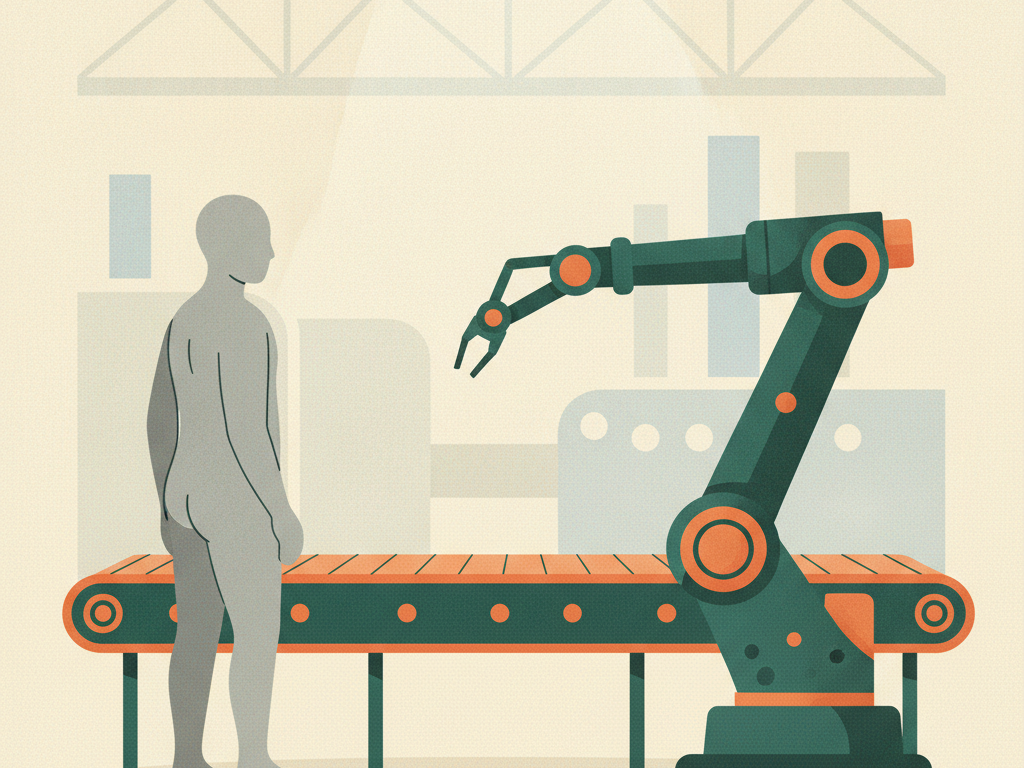
Tension on the manufacturing floor is more direct. Hyundai Motor announced at CES 2026 that it will deploy the humanoid robot Atlas in phases at its plant in the U.S. state of Georgia starting in 2028. In a survey of 5,425 workers at the Ulsan plant, 8 out of 10 said they felt a sense of crisis at the arrival of Atlas. The Hyundai Motor branch of the Korean Metal Workers' Union stated in a Jan. 22 newsletter that robots cannot be brought into the plant without an agreement between labor and management.
The same calculation is running abroad. Amazon laid off 30,000 white-collar workers over three months, and as an internal plan to automate about 75% of its operations over the long term was reported, the contents of a document saying that the introduction of robots could eliminate the need to create some 600,000 jobs also became known. An Amazon spokesperson distanced the company from this, calling it the view of one team inside the company. The Washington Post notified about 300 of its roughly 800 reporters of layoffs, citing the fact that online search traffic has fallen by nearly half in three years since the emergence of generative AI.
The actual capability of the technology is narrower than the announced plans. Amazon's touch-sensing robot system Vulcan handles a considerable share of picking and stowing in warehouses, but it runs at only a few facilities and handles only items on the top and bottom shelves of four-tier mobile racks. The two middle shelves are still the work of people. Tye Brady, chief technologist at Amazon Robotics, said in an interview at a conference held in London that the headcount at a warehouse with 1,000 employees would not fall even after robots are expanded, but the statement runs directly counter to the same company's internal document.
Discussion on the policy side is also moving. The Ministry of Planning and Budget and the Mid- to Long-Term Strategy Committee held a future society strategy subcommittee meeting on Feb. 5 and took up the shortage of youth jobs. At the World Economic Forum in Davos last January, the labor market impact of AI was also raised as a main agenda item, and AI was rated low as a short-term risk and high as a long-term risk 10 years out, as a key factor that will reshape the labor market. At this conference, where Kang Sung-jin, 62, a professor of economics at Korea University, took on the post of president of the Korean Economic Association after his inauguration, the Yellow Envelope Act, set to take effect in March, was also mentioned as a topic of discussion.
What is needed right now is to redesign the training path. If the way new hires built their skills through finely divided tasks no longer works, education and hiring standards that teach them to handle the entire process with AI in hand from the start have to follow. Robot deployment comes in 2028, the Yellow Envelope Act next month, and youth employment statistics every month. Which side moves first will determine the first jobs of people in their 20s over the next few years.