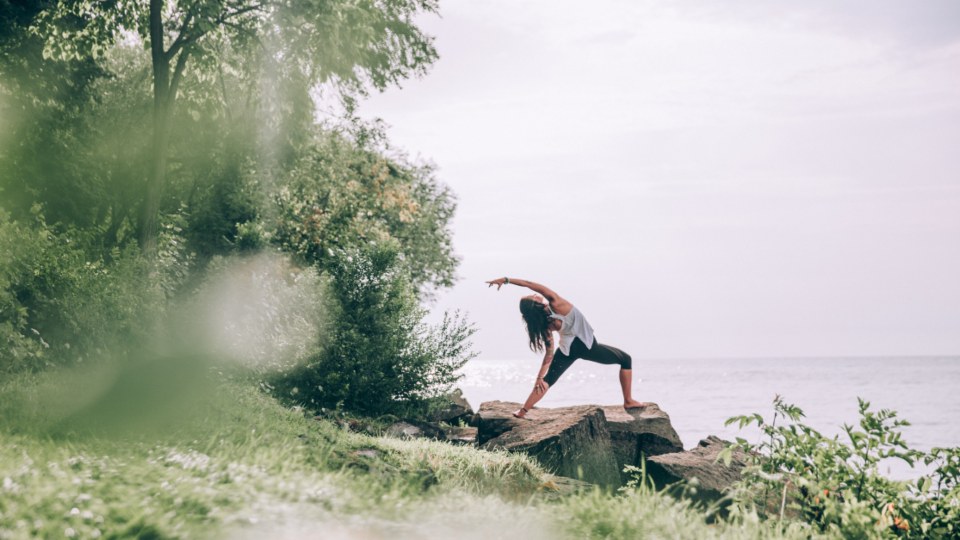
It is a waterside on an overcast afternoon. The sky and the water's surface loosen into nearly the same light, and from the left, trees and grass push into half the frame. A leaf brushing past the lens blurs and spreads, laying a thin film over the whole scene. Beyond that film, on a crumbled rock, a person stands still with legs apart and the upper body bent backward.
Standing still does not mean the strength has gone out. The soles of the feet are reading the angles of the uneven stone one by one, and the outstretched fingertips take their share of the weight of balance in the air. What is used most in holding a still posture is the breath. When the breath grows shallow, the posture is the first thing to waver.
In workplaces and in caregiving there are similar pauses. Time in which nothing appears to be happening on the outside, the few seconds of arranging one's expression in front of a child, the moment of swallowing the next words at a patient's side, a sigh in the hallway before opening the classroom door. Those few seconds do not count as break time, but what holds up that person's day is usually time like that.
The rock in the photograph is not flat, and the ground by the water is always giving way a little. What makes it possible to hold a posture even in such a place is not firm footing but keeping hold of the breath. We often tell those who are enduring to try harder, but what is actually needed is often a place to breathe.
I look at the photograph again. The tilted-back neck and the closed eyes, and within that brief stillness there is a breath being drawn in. When that breath ends, this person will release the posture and come down from the rock. Until then the frame is quiet.