

At the World Economic Forum annual meeting in Davos, Switzerland, International Monetary Fund (IMF) Managing Director Kristalina Georgieva said that within the next few years AI will affect 60% of jobs in advanced economies and 40% of jobs worldwide. That same week in South Korea, figures showed that accounting firms' hiring of newly certified accountants had fallen more than 30% from the period when it exceeded 1,200 a year. Nvidia Chief Executive Jensen Huang said AI will redefine jobs rather than eliminate them.
The three sets of remarks and the one hiring statistic differ in tone but converge on the same conclusion. Entry-level roles are shaking first.
Georgieva cited the IMF's own research showing that the tasks AI mainly replaces are the entry-level roles performed by young workers. She added that in advanced economies, one job in 10 is enjoying an "augmentation" effect in which AI raises productivity and wages together. Augmentation refers to improving the performance of the tools people use rather than removing people. It means the same technology raises wages in some roles and narrows the entrance to others.
Domestic indicators point to the same place. The Bank of Korea has analyzed that youth jobs in South Korea fell by more than 200,000 over the past three years. Oh Sam-il, head of the Bank of Korea's employment research team, framed the current situation as a problem of "employment realignment," noting that people are not moving from disappearing jobs to new ones. The diagnosis that movement is blocked is more serious than the diagnosis that the total has shrunk.
The figures are hard to read as a single whole. In South Korea, a forecast has been presented that 27% of all jobs will be affected once physical AI, meaning AI such as robots that works directly in the physical world, is commercialized. Its scope and criteria differ from the IMF's 60% and 40%, so the numbers cannot be placed in the same table and compared.
"Affected" and "replaced" are also different concepts. Putting the partial automation of tasks and the disappearance of a position itself in the same column always inflates forecasts beyond what actually happens.
Explanations of the causal path diverge as well. The IMF sees AI as replacing young workers' entry-level roles, but accounts from corporate workplaces in South Korea describe the reverse order. Firms hand entry-level work such as organizing materials and drafting basic reports to AI, and as a result hire mainly experienced workers. Whether technology pushed people out or hiring strategy changed first leads to completely different responses.
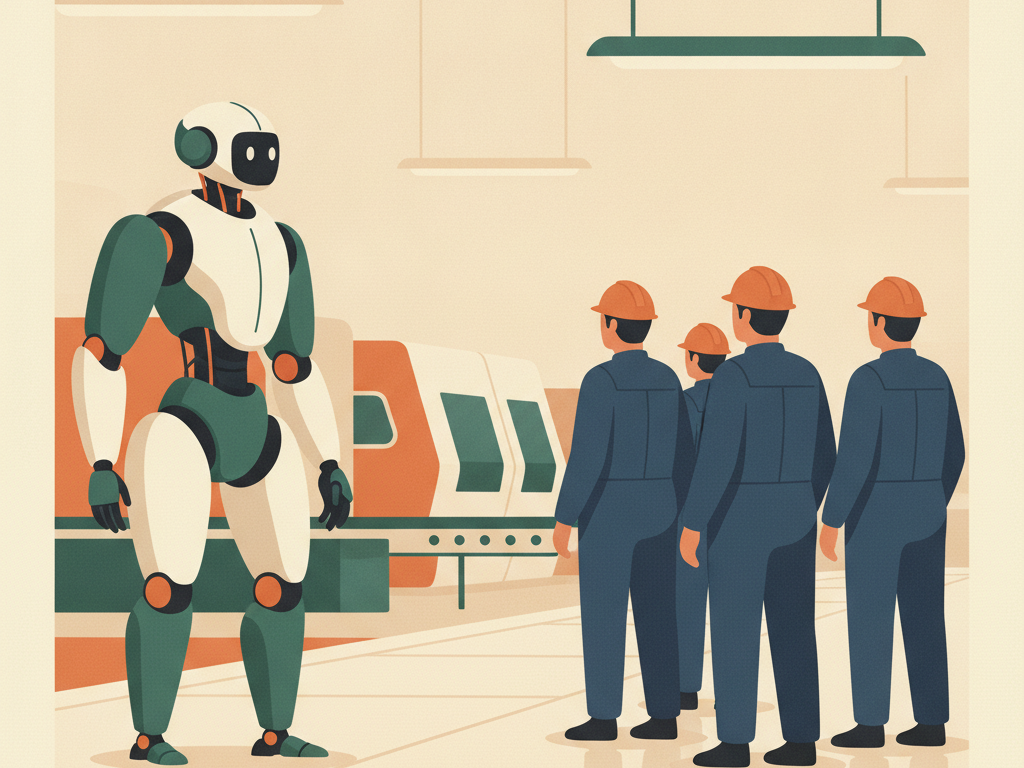
On the physical labor side the conflict is more direct. When Hyundai Motor announced it would introduce the humanoid robot "Atlas," the Hyundai Motor union stated its opposition, saying "not a single robot can be brought in." One Atlas unit costs 200 million won, but if 30,000 units are introduced the unit price is expected to fall to 47 million won.
Mass adoption pulls the price down, and the lower price draws further adoption. The global humanoid robot market is projected to grow from 4.3 trillion won last year to 22.4 trillion won by 2030.
Tesla Chief Executive Elon Musk said Optimus robots will outnumber all the surgeons on Earth. At Davos, optimism and pessimism were presented side by side. While these statements compete, what has actually been settled is only the price tag of a single robot and an adoption plan still short of execution. The 30,000 units are a planned figure and 47 million won is an estimate, not a contract price.
Policy, for now, is not keeping up with this change. The Ministry of Employment and Labor held a forum late last year on the theme of "Artificial Intelligence Industrial Transition and Jobs," and the experts who attended assessed that most jobs will shift to a form in which humans and AI collaborate. The ministry plans to announce an "AI response jobs roadmap" within the year. But no concrete policy measures such as retraining budgets or support for job reassignment have been made public.
The debate over replacement versus redefinition is in fact a question of time frames. Over the long run roles will be redefined, but for a person standing in the transition, redefinition is no different from losing a job. The drop in accounting firm hiring mixes AI factors with economic conditions, and how much belongs to each has yet to be separated out. A roadmap built without that distinction will miss both its targets and its budget.
For someone writing a first resume this year for an entry-level role, ratios like 27% or 60% are of little use. What matters is which stages in the role they are applying for were automated some time ago, and what to pick out from the stages that remain. The place to check when the Labor Ministry's roadmap arrives is the same. Rather than how many forecasts it cites, look at how many bridges it builds for displaced people to cross to their next job.