
The number of AI agents companies put to work is rising sharply. One company's AI agent count was given at around 150,000, and Dell said the era in which companies use agents by the thousands has arrived and that the way people work itself must change. Around the same time, "zombie agents" left idle while holding access rights were raised as a security risk, and Somansa released an AIDR solution that controls "shadow AI agents" and manages them as assets. The rush to adopt and the absence of controls surfaced at once.
Unlike a chatbot that answers each time a person gives an instruction, an AI agent is software that takes a goal, breaks the procedure down on its own and carries it through to execution. Execution requires access rights. It needs an account to log into internal systems, read documents and step into approval flows. The account issued when a single human employee is hired is now being stamped out by the thousands.
Adoption has reached the core of corporate operations. SK AX is understood to be pursuing an enterprise AI agent service, in partnership with SAP, that applies across corporate operations including ERP. The partnership centers on "SAP Autonomous Suite," SAP's autonomous operating environment for AI agents, and the goal is to automate repetitive work and shorten decision-making and processing time.
ERP is a company's core software, handling finance, purchasing, human resources and inventory in one system. When an agent reaches into it, it holds access rights of that scale.
Traces of the growth show up on the network as well. A figure was presented showing internet traffic from AI agents rose 1,700 percent. Requests generated by people opening browsers are not included in that figure.
It means requests that software generates on its own, without a person, have grown by that much. The baseline period for this growth rate has not been disclosed.
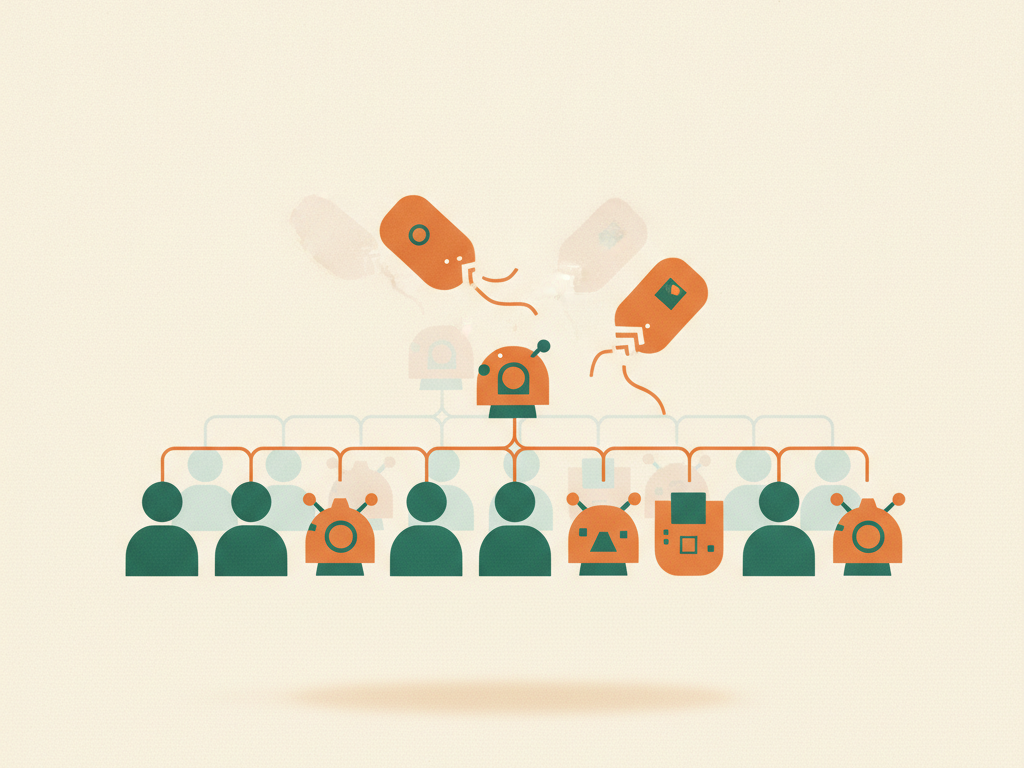
The problem is revocation. When a human employee resigns, the HR team locks the account and takes back the ID badge. AI agents do not resign.
For an agent that some department built as a trial and forgot after the project ended, the access rights it was granted remain alive. The term "zombie agent" has emerged for such agents.
On top of this there is another layer called "shadow AI agents." The term refers to agents built and used in the field without the company's knowledge, and it is also what the AIDR solution released by Somansa targets. What stands out is that it attaches control and asset management together. It treats making a list of what is running and how many as the first step of control.
The shape of organizations is shifting as well. There has been talk of Silicon Valley companies converting to "AI agent coexistence organizations" in which people and AI agents work together. But to speak of coexistence, the other half of personnel management, letting go, must also be designed. What is in place now is only the half that corresponds to hiring.
The figures have not been reconciled. Dell's "thousands" and the "150,000" are hard to group as the same metric because they differ in what was counted and as of when. Even so, they agree that the numbers are rising. The point where the objects of management outnumber people was passed some time ago.
In the end, this change starts by redefining whose job it is. Until now, issuing and revoking accounts has been split between IT and HR, but when accounts that move on their own grow into the thousands, it fits neatly into neither department. What an organization adopting agents should check next is the roster. How many are connecting where and with what rights, and how many of them can be shut off today.