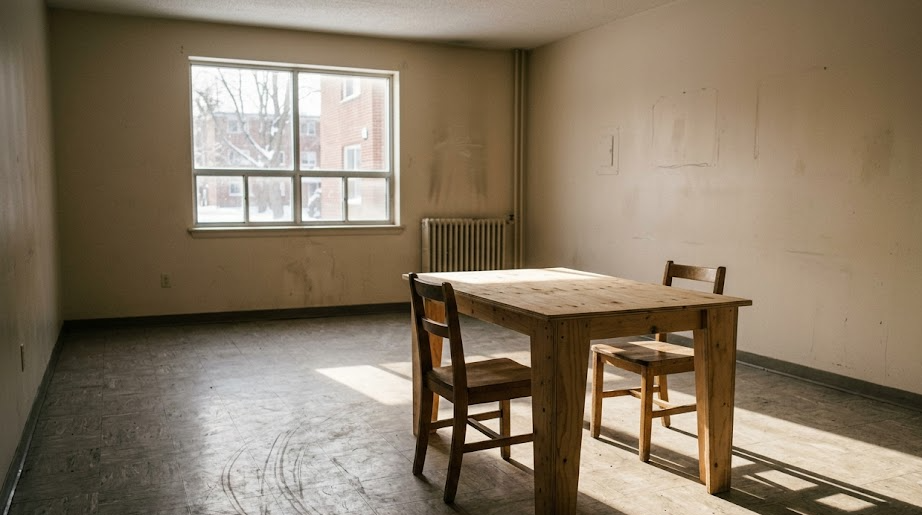
A three-story multi-household house in Bupyeong 5-dong, Bupyeong-gu, Incheon, opened in 2019 as a share house for young people. It was one part of the 'Dodeumjip Project', Incheon's first social housing pilot, in which Incheon Urban Corporation (iH) entrusted the operation to a social economy organization based in Seoul. Around 10 a.m. on the 22nd, only bags of cement were left at the entrance of the building, and the shared workroom and shared kitchen on the first floor were empty. On the same day, a 'policy forum for implementing Incheon-style social housing' was held in the meeting room of the Incheon City Council's Construction and Transportation Committee.
Dodeumjip was an attempt to tie together old downtown regeneration and housing welfare. Old houses are renovated and rented to young people and single-parent families, and the first floor is opened as a shared space that connects to the neighborhood. Under this arrangement, the social economy organization covered 20% of the remodeling cost. It was a design that divided the work of fixing up the housing from the work of gathering people and managing relationships.
A four-story multi-household house in Juan-dong, Michuhol-gu, carries a sign reading 'Living House by Dodeumjip'. It was created as a model that combines housing tailored to single-parent families with community activities. The community workshop on the first floor is not open on a regular basis now, and opens only on days when a reservation has been made. The sign and the space remain, but what was supposed to take place inside every day has shrunk.
The discussion at the forum aimed precisely at this empty spot. Chairman Choi Hwan said that social economy organizations within Incheon have had virtually no part in operating the city's social housing, and that organizations from other cities and provinces have led it. He also pointed out that organizations with the operating capacity for management and tenant recruitment are themselves scarce, so measures to build up expertise are needed. His title is written inconsistently as chairman of the Incheon Social Enterprise Council and chairman of the Incheon Social Economy Enterprise Council.
The thin local base shows in the statistics as well. In Incheon there are 44 housing-related social economy organizations, about 4% of the total. Jeong Hye-young, secretary general of the Incheon Village Management Social Cooperative Council, said that in recent years there have been almost no cases of public institutions buying houses in the old downtown and supplying them as rentals. That means neither the side that renovates and offers the housing nor the side that runs it has grown much within the region.
The institutional footing is shallow too. Yoon Hye-young, a research fellow in the Urban Space Research Department of the Incheon Institute, assessed that social housing has no clear governing law and leans on local ordinances, and that the institutional and financial support system between the central government and local governments is insufficient. In Incheon, the 'Ordinance on Support for Revitalizing Social Housing in Incheon City' passed the city council in February 2025. The ordinance now exists, but there is no law above it to support it.
Two directions were presented as alternatives, a 'locally proposed' type centered on local social economy organizations and a remodeling type that converts non-residential buildings. There was also a proposal to look at specialized models with narrowed targets, such as young artists or newlywed couples, using newly built housing of 30-50 units or purchased rental housing. The approach is to take it step by step from a pilot project, either by taking part in the Ministry of Land, Infrastructure and Transport's competition for regionally restricted specialized rental housing or by having iH push a non-residential remodeling social housing project. Lee Han-sol, chairman of the Korea Social Housing Association, named nonprofit supply by private operators, the function of a local hub space, community revitalization, and housing services linked to social economy organizations as the core elements.
The Incheon city government said it would give thought to finding social economy organizations and other measures. Which department will take it on, and when and with what budget it will be pushed, is not known. More than a year after the ordinance passed, whether local organizations are included on the list of participants in the next pilot project is expected to decide whether this discussion is carried out.
The shutter of the Bupyeong 5-dong building is down, and the Juan-dong workshop opens only on days with a reservation. Both are houses that were renovated for someone to live in, and they still stand in those spots. What has changed is that people have begun to discuss the reason they are empty as a problem in a design that did not raise operators in the region, instead of laying it on the operator's failure.