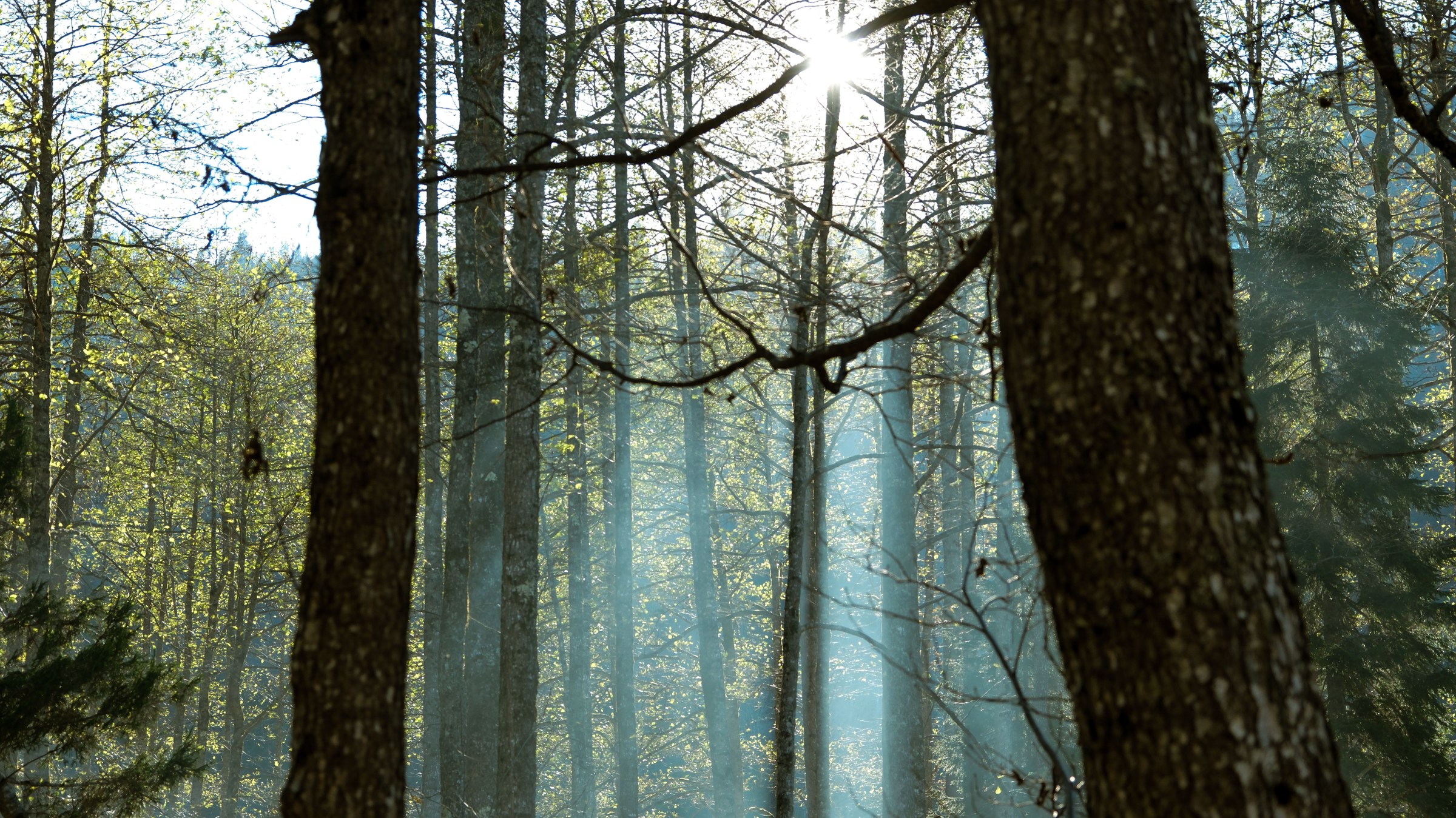
A thick trunk blocks the far left and the far right of the frame, one on each side, running vertically. Through the open gap between them, some fifteen slender trees recede into the back. In the upper third, where the branches fork, a single white point bursts, and the bundle of light coming out of it slants down to the bottom of the frame. This is a forest at around eight in the morning.
The beam of light is visible because the air is not empty. Moisture that rose all night from the soil and the leaves lies thinly between the trees, and each of those particles throws the light back, making it look like a thick bundle. Morning in the forest is the time when the forest briefly shows the breath it has exhaled to human eyes.
The pale green leaves are gathered at the lower left and behind the center. We know what those leaves do all day. They draw carbon from the air and turn it into their own bodies, and those bodies become trunks, become bark, become fallen leaves that pile up in the soil underfoot.
When the words carbon neutrality sound distant, it helps to think of those fifteen or so trees standing under the bundle of light. Simply by leaving them uncut, this work continues today as well.
Look again at the thick trunk on the right. Over the rough bark, grayish white stains spread like a map. These are lichens.
They are the organisms that vanish first when the air turns foul, so those patterns are a sign that the air this forest breathes in is clean. The sun will rise on the same side tomorrow too, but those stains on the bark can be erased depending on what people do.
Not the beam of light, but the moisture and the grayish white patterns that made that light visible, look at them once more.