The National Museum of Korea posted an apology on its website on the 12th. It was issued in the name of Director Yoo Hong-jun. It followed a tip that the calligraphy work "Ilbansigugeun (一飯是國恩)," introduced in the special exhibition "Our Tables" as a work by the patriot Park Won-geun (1912-1950), may be the writing of Park Jung-yang (1874-1959), a pro-Japanese collaborator. Director Yoo acknowledged that the verification procedure for exhibition items had been inadequate, and said the museum would cross-check the provenance of artifacts along multiple lines from now on.
The phrase itself carries weight. It means that even a single bowl of rice is entirely the nation's grace. It comes from the words of the Buddhist monk Yeonggyu, who raised a monk-soldier force and fought during the Imjin War. The name signed beside those eight characters was "Park Won-geun," and the tip pointed out that the name was another name used by Park Jung-yang.
Park Jung-yang served as governor of Hwanghae Province and governor of North Chungcheong Province during the Japanese colonial period, and rose to become an imperially appointed member of the House of Peers of the Imperial Diet of Japan. In 1919 he took part in suppressing the March 1st Movement. The "Encyclopedia of Korean Culture," citing the 1935 edition of the "Register of Meritorious Persons of Joseon," records that he was named one of the greatest contributors over the 25 years of colonial rule. Park Won-geun, a native of Boeun, North Chungcheong Province, was posthumously honored as an independence patriot in 2009.
A photograph was released showing Park Yong-hyun, the son of the patriot Park Won-geun, kneeling and weeping before the work in the exhibition hall. There is also an account that family members were present with him.
There is a record that this calligraphy work was put up at an art auction in 2019 as a work by the patriot Park Won-geun. The museum took that auction record as its basis in selecting the piece for the exhibition. It has been pointed out that the museum accepted the existing attribution as it was, without a separate cross-check of its own. The museum has not disclosed the details of the winning bid at the time of the auction or the current ownership history.
The museum took the work down and began an expert appraisal. The final author will be determined only once the appraisal results come out.
When a single name tag changes, the meaning of an artifact changes. The sentence "even a single bowl of rice is the nation's grace" means the opposite when written by an independence activist and when written by a figure recorded as a contributor to colonial rule. At a museum that represents the country, that attribution was wrong.
There is always tension between collecting and displaying. Preserve only, and artifacts sleep in storage; hang them in haste, and verification gets pushed back. A plan to present, in time for the 80th anniversary of liberation, a phrase speaking of the nation's grace through the familiar subject of the dining table would have been hard for the exhibition organizers to turn down. In the end, the impulse to choose the subject ran ahead of the work of confirming the artifact's provenance.
Director Yoo apologized to the public in person at the start of a special lecture held in the museum's main auditorium on the 13th. The lecture's topic was the life and art of Chusa Kim Jeong-hui.
The date the tip arrived and the date the work was taken down can be narrowed to between August 10 and 12, but they have not been pinned down day by day. Accounts that the person who gave the tip was someone outside the museum and accounts that it came from the domestic calligraphy world are both circulating. What is clear is that this point did not come from within the museum.
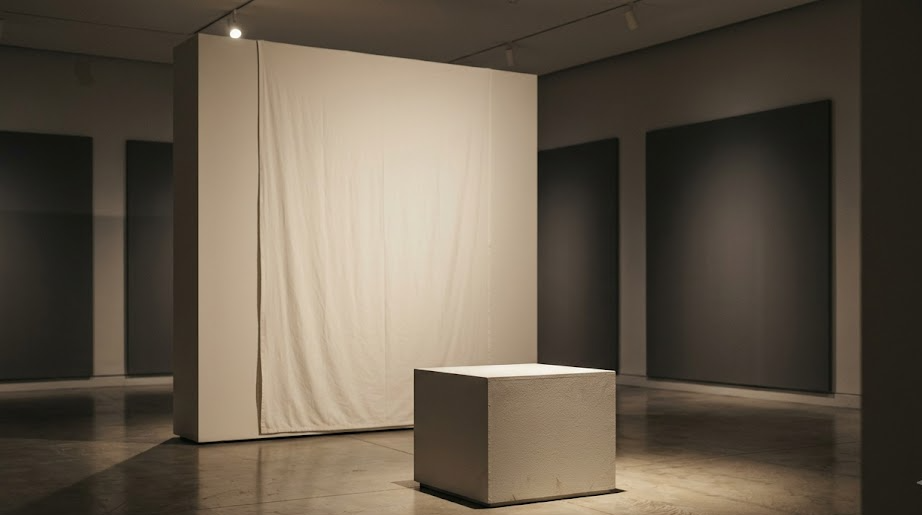
The special exhibition "Our Tables" is scheduled to run through October 25. The wall where the calligraphy work had hung is covered with cloth. Until the appraisal results come out, the wall will remain covered.