
The National Human Rights Commission of Korea has launched a survey on AI and labor rights covering 1,750 workers. It is the largest such survey the commission has conducted. A day earlier, on June 7, the Bank of Korea released an issue note examining the effects of the first three years of generative AI adoption. Two pieces of work, one digging into how much AI reduces human labor and the other into how people are treated in that process, were released two days apart in the same week.
The commission's survey is being carried out under contract by the Working Citizens Institute. The questionnaire is divided between 1,250 workers and some 500 labor and management officials. In-depth interviews are being conducted across 12 industries including metals and finance and 10 occupations including webtoons, transport and delivery, and the commission's "artificial intelligence human rights impact assessment" tool is being applied at 340 public sector organizations.
A human rights impact assessment is a procedure for checking the effect a system has on people's rights before and after its introduction. The commission recommended "artificial intelligence human rights guidelines" in 2022 and issued these assessment criteria in 2024. After four years in which the recommendation and the criteria existed only on paper, they are being applied in the field for the first time. The research team plans to open an online "artificial intelligence labor observatory" in September to collect adoption cases and reports of human rights violations.
The Bank of Korea's analysis looks at the same field from a different angle. Drawing on a household survey of 5,512 employed people aged 15 to 64 conducted in May and June 2025, it found that average working hours fell 3.8% among people who use generative AI. On a 40-hour week, that is 1 hour 30 minutes.
The correlation between the extent of the reduction in working hours and changes in an individual worker's productivity was estimated at zero. No clear link was found between how much AI is used in an industry and how much labor productivity rises there either. The Bank of Korea estimates that productivity could rise 1.0 percentage point if the saved time were put back into production, which means, read the other way, that this reinvestment is not happening now. Hours clearly fell, but where those hours went did not show up in the statistics.
The effects are not evenly spread either. The increase in workload handled was 0.7 percentage point higher for professionals than for office workers, 0.5 percentage point higher for the top half in AI usage time than for the bottom half, and 0.6 percentage point higher for those aged 15 to 39 than for those aged 50 to 64. Gender, education and length of service produced no significant differences.

The 2024 survey of business activities put the AI utilization rate at 9.6% among firms and 51.8% among workers. Companies are not saying they have adopted it while individuals are using it, and the gap between the two figures itself shows the route by which this technology entered organizations.
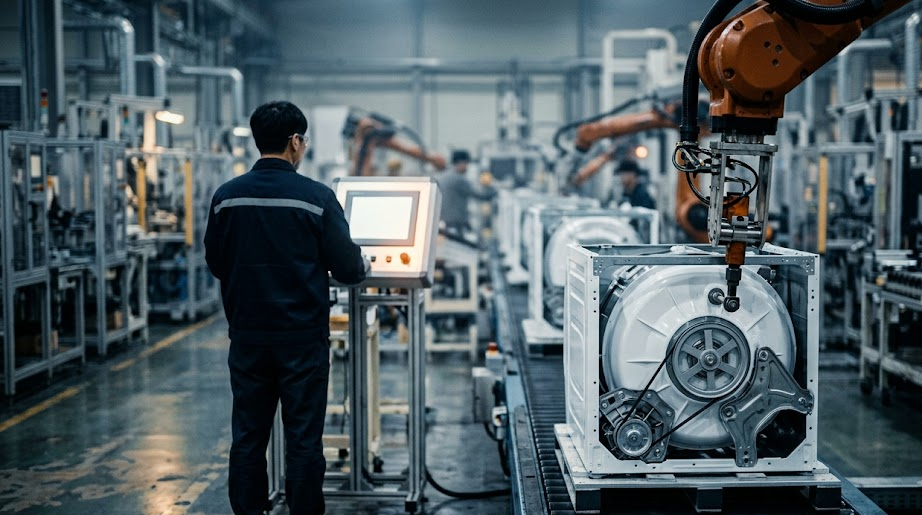
The arithmetic on the ground diverges from the statistics. Shin Sung Delta Tech, a home appliance parts manufacturer, began adopting AI in earnest three years ago, and its chief executive said that after the equipment was installed, work once done by 100 people came to be done by 60. At the Changwon plant, four workers in a team used to drive 17 screws into a single washing machine, but now robots assemble the units while adjusting tightening force, and image reading equipment known as "vision AI" screens out defects. The company said it had maintained its workforce.
Conditions outside are not moving that way. Major banks are expanding the scope of automation on the assumption that AI will reduce jobs, and hiring of entry-level analysts is projected to fall by as much as two thirds. Jamie Dimon, chief executive of JPMorgan, said AI will eventually eliminate jobs. Amazon announced a plan in January this year to cut 16,000 jobs, and Meta decided to reduce its workforce by 20% by 2028.
The decline shows up in domestic indicators as well. In April 2026, the number of people employed in professional, scientific and technical services fell by 115,000 from a year earlier, the largest drop since the statistics began in 2013. How much of that decline is attributable to AI has not been established. Productivity has not risen while people alone keep leaving.
The commission's survey therefore focuses on how workers are treated rather than on efficiency. Who is evaluated by which algorithm, what data is collected during work, and on what basis dispatch and assignment are decided are among the survey items. Webtoons, delivery and transport were included among the in-depth interview targets because these are jobs in which work is received from a system in place of a person. The timing of the release of the results has not been fixed, but reports will begin to be accepted once the observatory opens in September.
An hour and a half a week is time in which a person can eat one more dinner, deal with paperwork that has piled up, or do nothing. Whether that time stays with the individual or is absorbed into a company's next target is not decided by the technology. A procedure has now begun for finding out where the hands of those four people who tightened screws at the Changwon plant have moved, through the responses of 1,750 workers rather than the company's account.