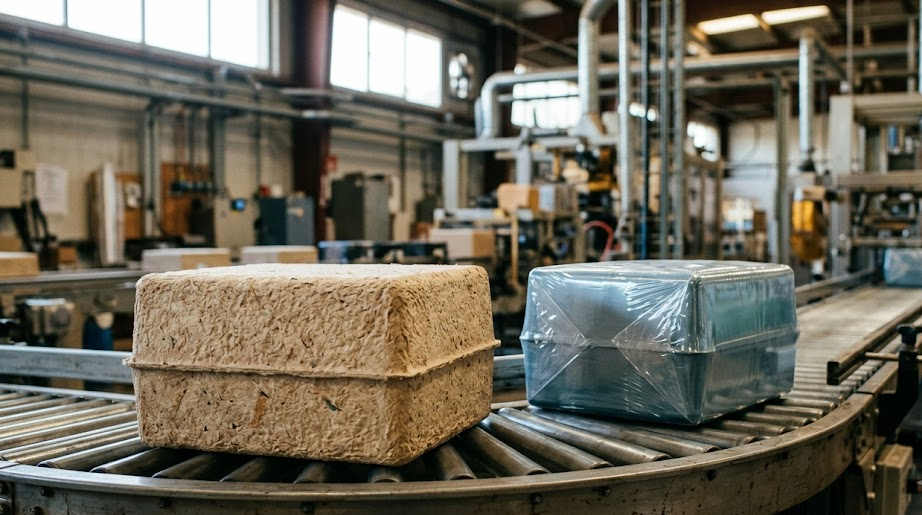
Musinsa signed a business agreement on the 2nd with Greeco (그리코), an eco-friendly bio-material company, at Musinsa Seongsu E1 in Seongsu-dong, Seoul, to expand eco-friendly packaging and cooperate on sustainable management. The agreement covers joint planning and development of eco-friendly packaging materials, wider application of materials to replace existing plastic packaging, ESG-based joint projects and campaigns, and carbon reduction activities. Around the same time, '2026 Green Consumption Week' opened, and Hyundai Department Store launched an eco-friendly campaign to mark Environment Day. Policies and corporate programs flying the flag of green consumption were concentrated in a single week.
Greeco is a startup that holds technology for producing and processing materials and packaging made from agricultural and fishery byproducts such as rice and rice husks. Musinsa will test the eco-friendly packaging on major products of its own brand Musinsa Standard and then review whether to adopt it formally on the basis of the results. The test volume, the number of items covered and the timing of the review are not known. The company said it plans to convert its existing packaging to bio-material products based on agricultural and fishery goods in stages, but it did not give a conversion rate or a target year for completion.
Cited as background to the agreement were growing supply uncertainty for oil and naphtha, the raw materials for plastic, and the tightening of environmental regulations in the global fashion market. Musinsa said the agreement is meant to respond to the government's 'Plan for the Transition to a Plastic-Free Circular Economy.'
The side consumers feel directly is the department store program. Hyundai Department Store gives customers who take part in the eco-friendly campaign twice the previous mileage under its own reward program 'Green Friends.' No confirmed notice has been issued on the previous accrual rate, the campaign period or the range of stores where it applies. Benefits linked to the carbon neutrality point system run by the Ministry of Climate, Energy and Environment are provided as well.
Musinsa's is a supply-side response that changes the packaging holding the product itself, and Hyundai Department Store's is a demand-side incentive that adds points to the act of taking part. Designs that shift the practice of green consumption into monetary rewards, discounts and points, appeared together in several industries this week. It runs along with a trend in which the retail, IT and service industries are widening ESG practice through green consumption.
The next point to check is quantitative indicators. On Musinsa's side, the results of the test application, the volume converted and the reduction effect have to come out in figures before the substance of the phrase phased conversion can be measured. On the department store's side, what remains is what change the higher accrual rate produced in the number of participations or in sales of related products. Neither side has presented performance data showing the effect of the incentive design.
A change in packaging applies even when the consumer does not choose it, and mileage accrual works only when the consumer chooses it. Once Musinsa announces its test results and Hyundai Department Store's campaign tally comes out, it will be possible to see how much the two approaches were actually used.