522 people walked 5.22 km. This was the launch ceremony held on May 22 at the Sejong National Arboretum. On the same day, hands were busy picking up trash at the Jangnok Wetland on the lower Hwangnyong River in Gwangju, and a survey looking into the ecology began at the Sincheon Wetland on the Mangyeong River. Instead of a reading of a declaration, the International Day for Biological Diversity was marked as a day of sites scattered here and there.
May 22 is the Day for Biological Diversity designated by the United Nations. This year's domestic commemorative event was held in the DMZ. It has been confirmed several times that while the boundary dividing the South and the North kept people away for more than 70 years, the area became one of the leading refuges for living things on the Korean Peninsula.
The border area was not the only stage for the anniversary. From the 22nd to the 31st, the Korea Forest Service is running "Steps That Save the Forest" both online and offline. Signaled by the launch ceremony at the Sejong National Arboretum, the same walk was held at the same time at 34 arboretums and gardens nationwide, including Suncheonman National Garden. Korea Forest Service Minister Park Eun-sik also came to the Sejong event site.
The date of May 22 was carried over into distance as it is, with participants walking 5.22 km, and the number of participants was also set at 522. Online participants can fill 5.22 km, about 8,000 steps, wherever they are, and donate their steps through a QR code. Prizes through a drawing are also on offer.
Son Sun-cheol, head of the Forest Ecology Restoration Division at the Korea Forest Service, said he hopes the act of citizens walking itself becomes an occasion to draw interest in forest ecosystem conservation. The procedures and the scale by which the steps are carried over into actual conservation projects remain a matter to be disclosed separately. The easier a campaign is to join, the more showing what lies behind it transparently builds trust.
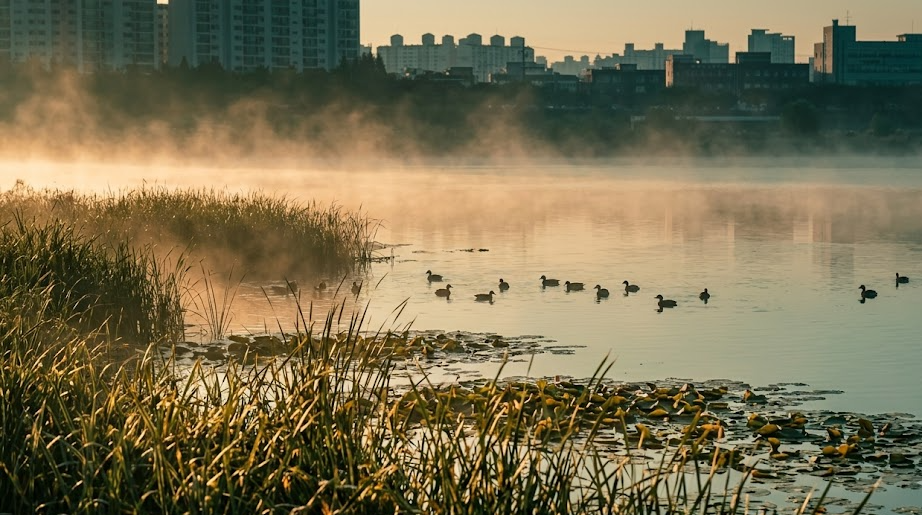
There are also results that took longer. The Jangnok Wetland is a river-type wetland bordering the city, and it became a national wetland protection area in 2020. A total of 829 species, including birds, fish, amphibians and insects, make their home here. It is not common for a wetland next to a city center to maintain a list of living things on this scale.
In Gwangju, discussions on listing the Jangnok Wetland as a Ramsar wetland are continuing. Lim Eun-chae, a director at the Gwangju Green Environment Center, added weight to this discussion through a contribution making the value of the wetland known. International listing is a matter in which administrative procedures and local agreement have to go together, so it takes time. In the meantime, the work of protecting the wetland is filled with tangible practices such as cleanup drives.
"Steps That Save the Forest" is open until the 31st. Whether on a stream path in front of the house or in a neighborhood park, 8,000 steps reach 5.22 km. Walk those steps today, and next time carry on in the order of picking up a bag at a nearby wetland. Biodiversity grows that way, one protected wetland at a time.