
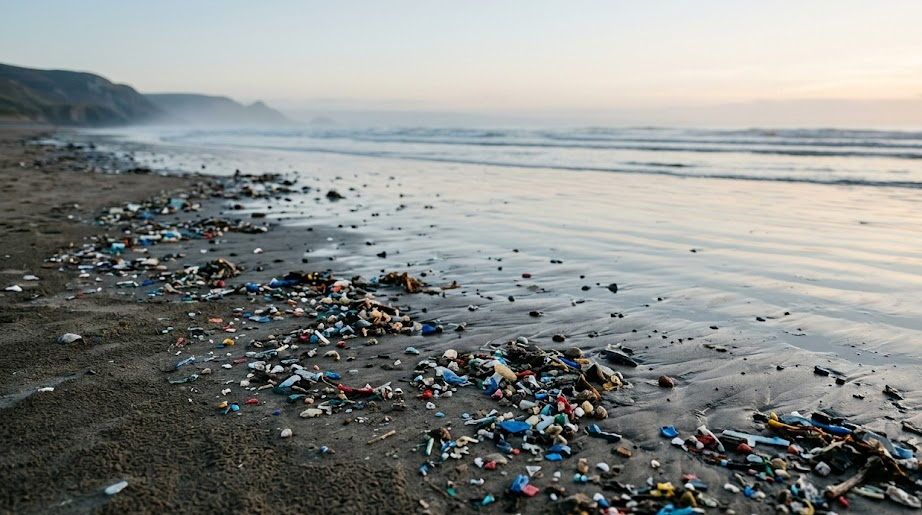
Follow the mark where the seawater has pulled back and a thin line remains. Faded fragments are packed densely among the seaweed and shells. The fact that a similar scene repeats on any beach shows the nature of this problem as it is.
A survey has found that 93% of the world's coastlines are covered in plastic. Around the same time, a marine collection project reported results showing that the amount entering the ocean could be meaningfully reduced within 15 years. At first glance the two pieces of news seem at odds. One says nearly every coast is polluted, and the other says a solution is in sight.
But place the two together and the discrepancy disappears. The 93% is an area too large to keep up with through scooping alone at sea, and the basis on which the collection project can speak of a 15-year timeline is that it caught the amount flowing in from rivers and estuaries. That is, the two announcements point to the same place. Shutting off decides success or failure more than scooping out does.
Think of an overflowing bathtub and it becomes easy. However diligent the person bailing with a bowl, the floor will not dry while the tap is open. Collection technology is an achievement that made the bowl in this comparison far larger and more refined. The most valuable information that achievement provided was the location of the tap.
The counterargument is strong enough. Reducing land-based discharge is slow because institutions and industrial transitions are entangled in it, and the fragments keep piling up in the meantime. The demand to hurry with visible collection at least is legitimate. The amount that has actually entered the sea does not disappear on its own, so there is no reason to stop the work of pulling it out.
The answer does not lie in choosing one of the two. The proposal is to continue collection while changing the unit in which results are announced. If, in place of how many tons were pulled out, we also count how much less was let flow from which river, publicity and real effect meet on the same indicator. The habit of counting only the amount pulled out is often used as an indulgence while discharge is left as it is.
Neither the claim that the ocean is about to end nor the claim that technology will solve everything captures this reality accurately. The 93% figure is less grounds for despair than it is a sign that the sources of pollution are not concentrated in particular regions, and a problem that has spread widely can be reduced only by a widely spread response. A few large machines will not solve it. It has to be reduced a little at a time at thousands of discharge points.
Picking up a fragment caught at the water's edge while passing a riverbank or a stream flat requires no tools and no qualifications. That fragment had not reached the sea, and it was an object that would cost far more to retrieve at sea. The calculation that one caught on land is cheaper than one caught at sea applies equally to the accounting ledger of a collection vessel and to the hand of a person walking along a river.