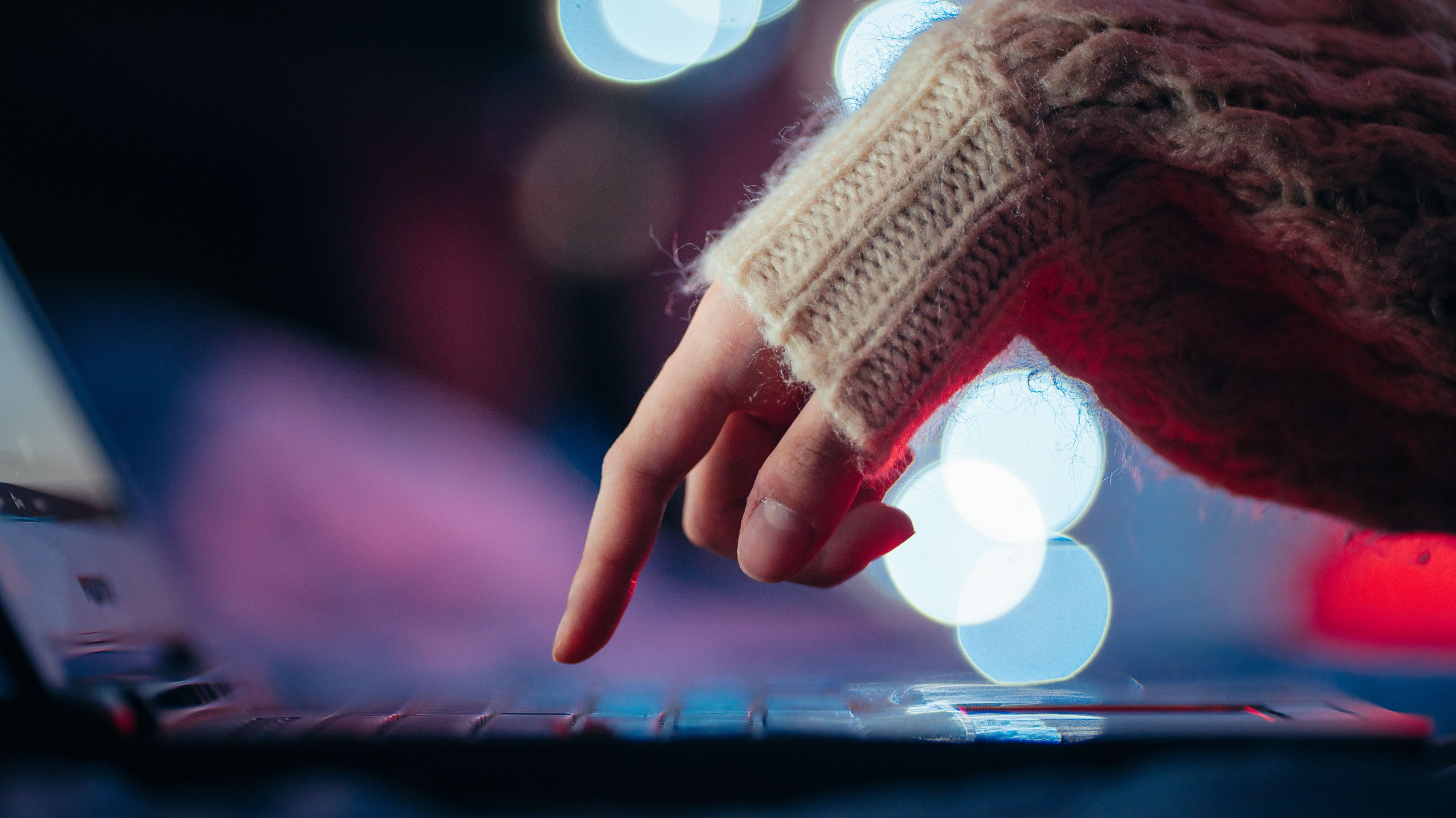
A knit sleeve covers the wrist, and only a single index finger extends beyond it. The fingertip has not yet touched the keys. Light leaking from the screen brushes the edge of the keyboard in blue, and behind it red lighting and white bokeh blur out of focus. It is evening or night, an hour when the lights in the room have already been turned off.
The subject of this photograph is neither the hand nor the screen but the few millimeters left between them. The moment that gap disappears, a person's intention turns into a machine's input. Most of what we call technology has been a competition over how short and smooth this conversion can be made. From buttons to touch, from touch to voice, and now it is moving toward sensing before anything is said.
The more that happens, the more the act of pressing a key looks outdated, yet at the same time it is strangely honest. The force of the press, the time spent hesitating, even the traces of erasing and writing again remain in the finger. As interfaces that take instructions like conversation increase, what we lose along with them is precisely this record of hesitation.
The warmth of the fingertip and the cold light of the screen sit in the same frame. One side is wrapped in wool, the other is glass and metal. The next stage of technology will be the work of bringing these two closer together, and when that happens, will what disappears be the distance or the hesitation?
In the lower right, where the screen's light does not reach, the remaining four fingers are folded in the shadow of the sleeve. While the index finger extends, they curl toward the palm and do nothing. A body not translated into input occupies the darkest part of the frame. What is always left out of the competition over smoothness is this part that waits, unused.
Looking at the photograph again, the finger is still coming down.