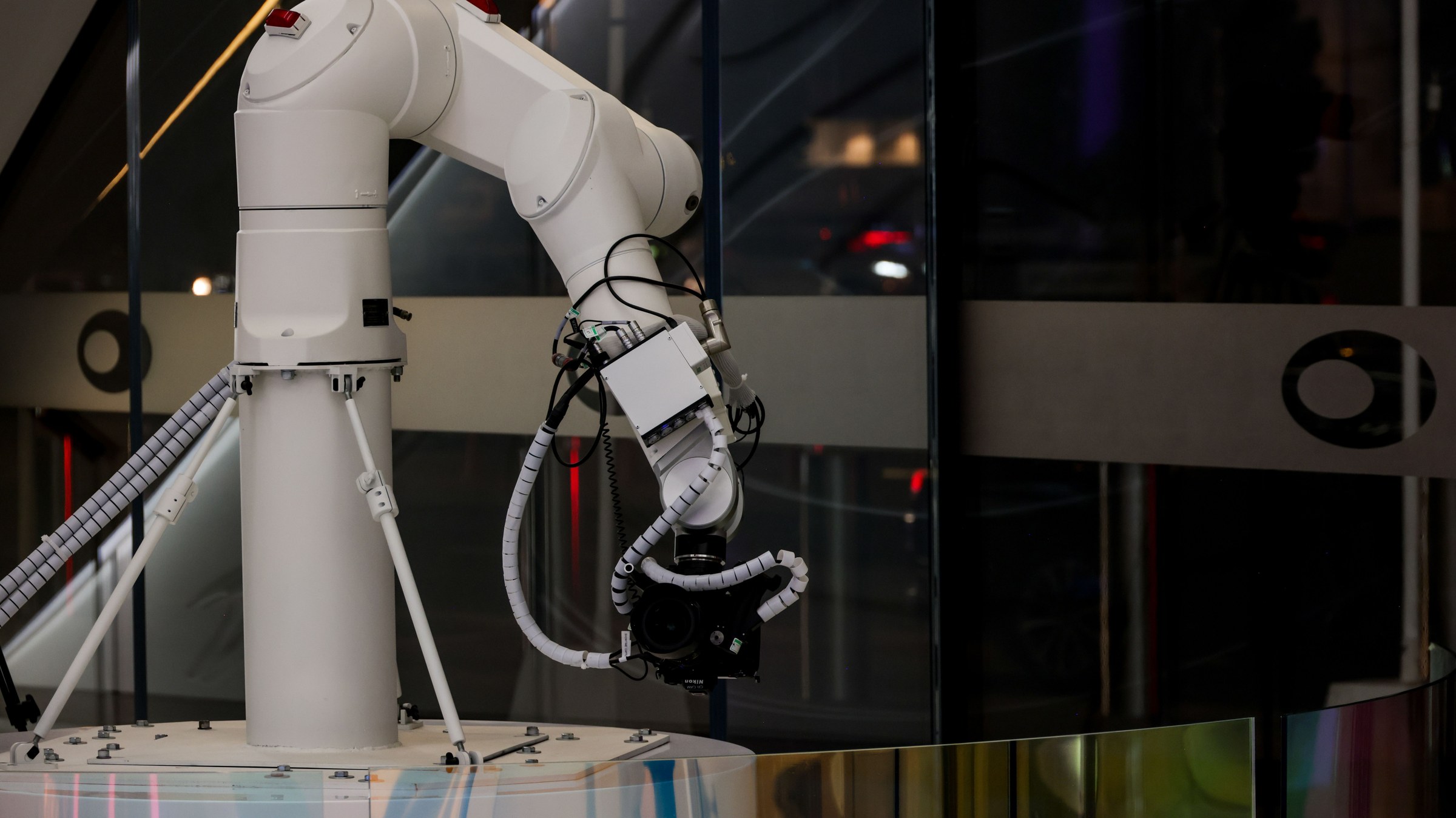
A white robot arm bows its head atop a cylindrical base. Black cables and spiral conduit run along the arm from joint to joint, and at the end a single piece of black equipment hangs, pointing downward. Behind it is curved glass, beyond which indoor lighting and a red glow spread out, and the hour is close to evening. Below the base, a glass railing with a rainbow sheen wraps the robot in one more layer.
This arm's original place is the factory. It is a machine built to repeat the same motion at the same angle beside a conveyor, and to work through the night without anyone watching. Here, though, it has been placed inside glass and become an object of viewing. The moment a tool of production becomes an object of exhibition, automation shifts from a question of performance to a question of attitude.
The white casing and rounded joints give the impression that there is nothing to hide. For a robot once confined behind safety fences to come out beside people, it had to prove softness before force, and predictability before speed. Even a single spiral conduit wrapped around the cables carries that kind of design calculation.
The bowed posture may be the end of a task, or it may be a wait for the next motion. A factory robot is at its most expensive when it is standing still, but here that stillness is used as a posture for display. Whether what we have demanded of robots is labor or persuasion, the angle of this evening asks again.
Looking at the photograph again, the glass may catch the eye before the robot does. That thin boundary, which decides what to keep inside and what to leave outside, is the shape of the line that will lie between the factory and the city.