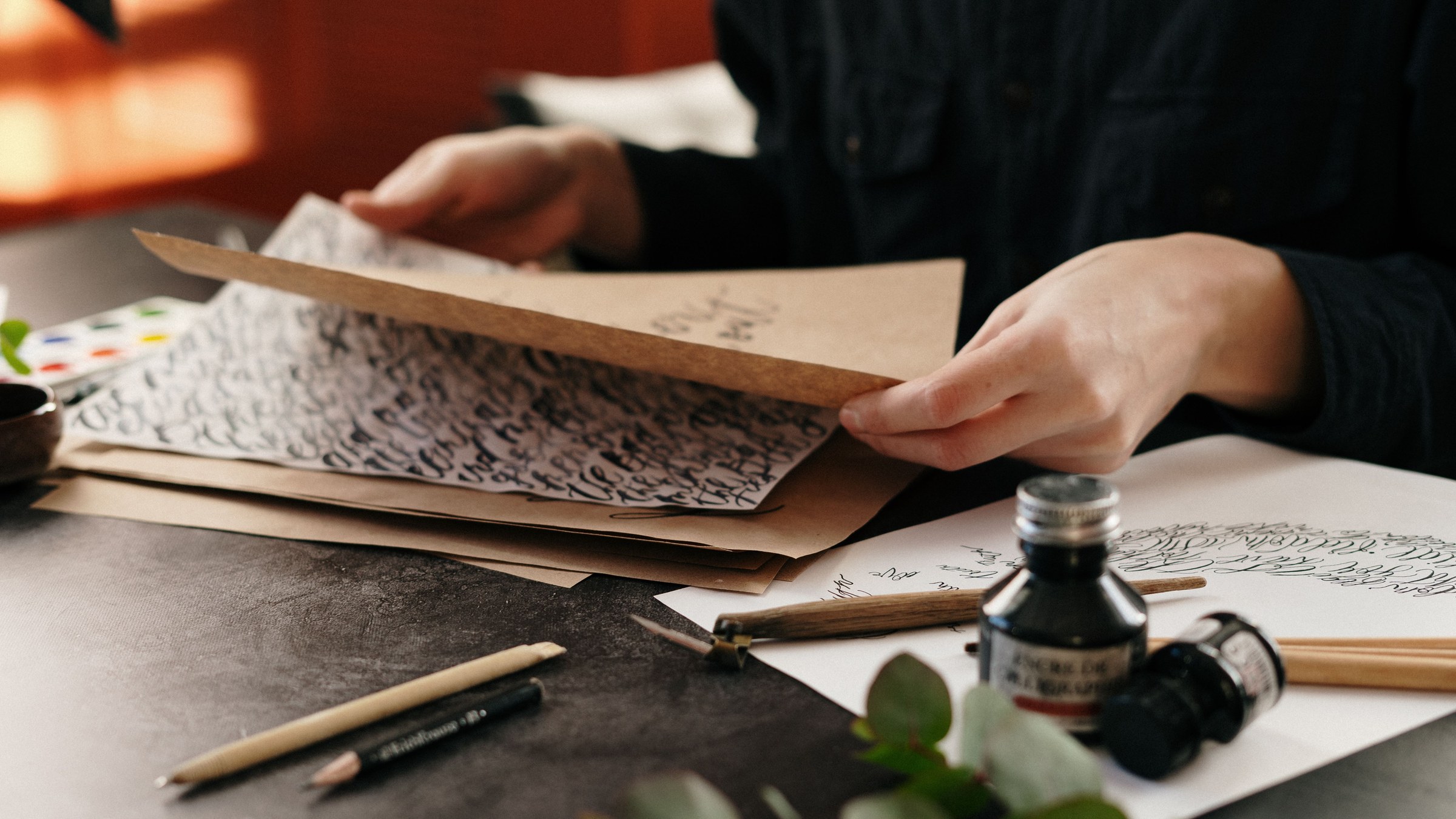
Several sheets of kraft paper lie stacked on the dark tabletop, and from among them a single leaf dense with black writing is lifted up. On the left wall the late afternoon light spreads in orange, and the glass of the inkwell holds just one point of it. A pencil, a wooden penholder and a eucalyptus sprig weigh down the edges of the paper.
Looking into a scene like this, the breath grows shallow and long on its own. The shoulders curl slightly forward, like the two hands holding the paper, and the eyes move past any single letter to rest on the whole grain the strokes have made. The sense of the soles touching the floor comes back a moment later.
When sentences that went unsaid pool for a long time, the middle of the chest turns sore. It is less that there is no way to reach the other person, and more that the words keep circling in the mind because they have found no place to come out.
You might tear off one corner of the paper and write just a single line you will not send. You can write the recipient's name or leave it blank. Once it is written, why not fold it and put it in a drawer, or simply slip it between the pages of a book.
It is just as fine to turn that same line over in your mind while waiting for the signal at a crossing. With no paper and no pencil, you end up folding and unfolding the sentence in your mind alone until the light turns green. What to watch for then is how much longer or shorter the inhale and the exhale become. It is enough simply to observe whether the length changes each time the sentence changes, or stays as it was at first.
While the ink dries the room grows a little quieter, and the light slides slowly down the wall.