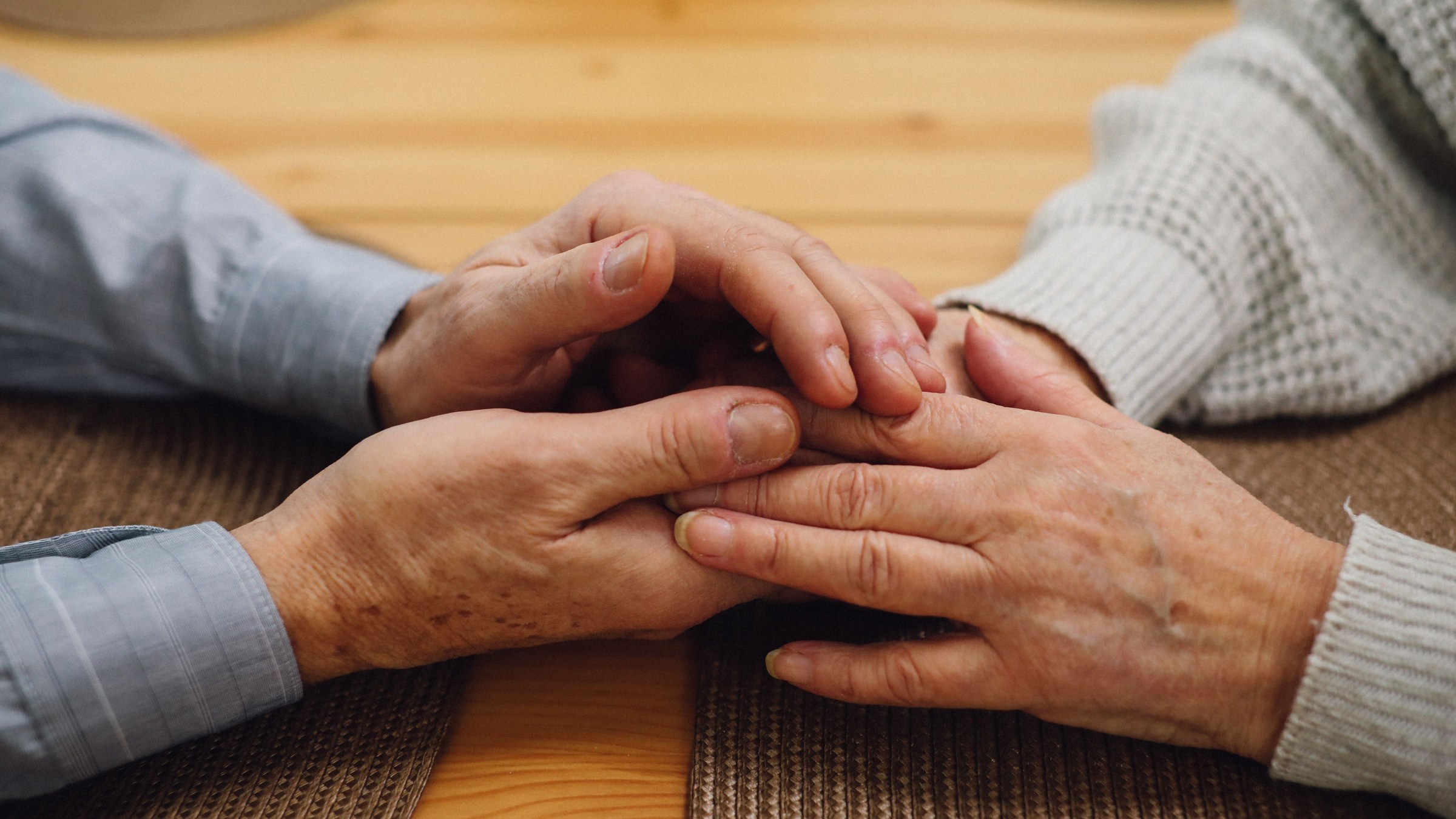
Four hands are stacked on a pale wooden table. The afternoon light spreads along the grain, and age spots, tendons and knuckles are laid bare. A gray shirt cuff and a knit sleeve come in from either side and meet in the middle.
The side doing the holding is not fixed to one person. There is a hand resting on top and a hand supporting from below, and in the photograph the two take turns. It also means that the one giving care and the one receiving it are not fixed as a single person.
Care usually takes place in a posture like this. A table rather than a hospital or a facility, an afternoon rather than a special hour, a few minutes that go unrecorded. Those few minutes accumulate, and a person's day holds up without collapsing.
This labor rarely gets a name tag. It continues inside the home with no working hours and no rest hours, and the person doing it does not bother to count what she is doing. It is common for the hand giving care to be a hand that itself needs care.
Below the table, in shade the light does not reach, another hand rests on a knee. It is pushed half out of the frame, with only the end of a sleeve barely visible. Someone must have been sitting there facing the four stacked hands, and a hand that waits without holding anything is also part of this afternoon. A scene of shared care always has an edge like this that falls out of the count.
Look at the photograph again. Who is holding whom is not sorted out at a glance. That point which is hard to see is the middle of what we now call care.