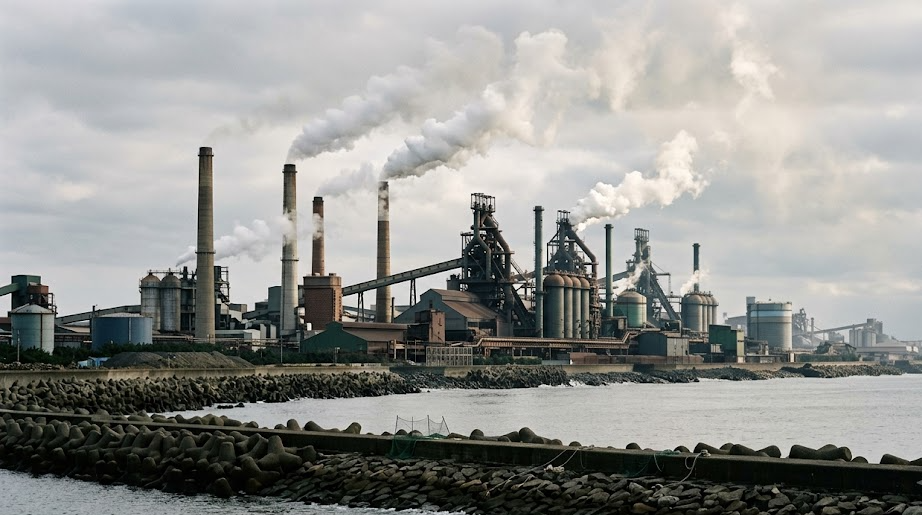
In the "Steel Company Scorecard 2026" released on March 31 (local time) by the international environmental group SteelWatch, POSCO scored 21.9 points out of 100 for 15th place, and Hyundai Steel scored 21.2 points for 16th. The assessment covered 18 major steelmakers headquartered in 11 countries. SteelWatch grouped the two companies in the same bottom tier as Nippon Steel and China's HBIS. This scorecard is the first assessment SteelWatch has published.
Not one of the 18 companies topped 50 points. The highest score was 46.2 points for Sweden's SSAB, followed by 41.9 points for Germany's Thyssenkrupp. The assessment consisted of 21 indicators across five areas, weighted as follows: phasing out coal 25%, scaling up the green transition 25%, social and environmental responsibility 20%, climate performance 15%, and targets and transparency 15%. The analysis drew on each company's sustainability disclosures, centered on 2024 data.
What separated the scores was facilities rather than declarations. POSCO operates eight coal-based blast furnaces in Korea with no electric arc furnace and has not put forward a closure plan, and it is pursuing a reline of the No. 2 blast furnace at its Gwangyang works. In an assessment where half the points hang on phasing out coal and scaling up the green transition, keeping blast furnaces in operation works as a deduction. How much the company will spend on the reline and when it will finish have not yet been disclosed.
POSCO and Hyundai Steel both reported zero renewable energy use. On the "green steel" indicator, covering production with carbon emissions of 350kgCO₂e or less per ton, the two companies also received what amounted to zero points. POSCO withdrew from the international initiative ResponsibleSteel in 2024, and that decision was reflected negatively in the external verification and transparency indicator and in the social and environmental responsibility indicator.
Circumstances differ somewhat at Hyundai Steel. Its high share of scrap use put its greenhouse gas emissions intensity below the average of the assessed companies, and it has announced plans to build a direct reduced iron-electric arc furnace (DRI-EAF) plant in Louisiana in the United States. On the other hand, it does not disclose its coal consumption and received a bottom-level rating on the data transparency indicator, and it has not presented a roadmap for closing its existing blast furnaces. Crude steel output in 2024 is put at about 35 million tons for POSCO and about 18 million tons for Hyundai Steel.
The report assessed POSCO's hydrogen reduction steelmaking project (HYREX) as being at the demonstration stage. Both companies have declared carbon neutrality by 2050, but neither has had its climate targets verified by SBTi. The report defined the gap between targets and actual facility transition and investment as a "transition readiness gap." The steel industry accounts for about 10% of global greenhouse gas emissions, and about 90% of the industry's direct emissions come from coal-based blast furnace processes.
The channel through which assessment rankings carry over into export costs is the EU's Carbon Border Adjustment Mechanism (CBAM). It puts a carbon price linked to the emissions trading system on the carbon content of six product categories including steel, and exporters must buy certificates corresponding to that content. Last year Korea's steel exports to the EU came to 4.3 billion dollars, the largest of the six categories covered by CBAM. Aluminum followed at 500 million dollars, fertilizer at 5 million dollars and cement at 1 million dollars, with no exports of electricity or hydrogen.
The government's response is concentrated on the funding side. It has decided to expand green finance aimed at carbon neutrality facility investment from about 3.8 trillion won this year to 9.4 trillion won next year. A total of 26.9 billion won went into basic technology development for hydrogen reduction steelmaking from 2023 to 2025, and support for demonstration projects will be pursued from 2026 following a review of its appropriateness. How much of that the steel sector will receive has not been made known so far.
Kwon Young-min, a researcher on the steel team at Solutions for Our Climate, said the two companies' bottom-tier results are a warning that shows their reliance on coal-based production and their delayed low-carbon transition. Solutions for Our Climate excerpted and translated the findings and distributed them in Korea on April 1. Steel is also the sector that emits the most greenhouse gases among Korea's industrial sectors.
The 21.9 and 21.2 points are not a gauge of how hard the two companies have tried. They are a gauge of how many blast furnaces remain and of whether it is written down when and how those furnaces will be changed. For the scores to move on the next scorecard, a roadmap with closure dates and disclosure of coal consumption will have to appear in the interval. How far the detailed schedule for the Gwangyang No. 2 blast furnace reline and the size of government demonstration project support are spelled out within this year will determine those conditions.