
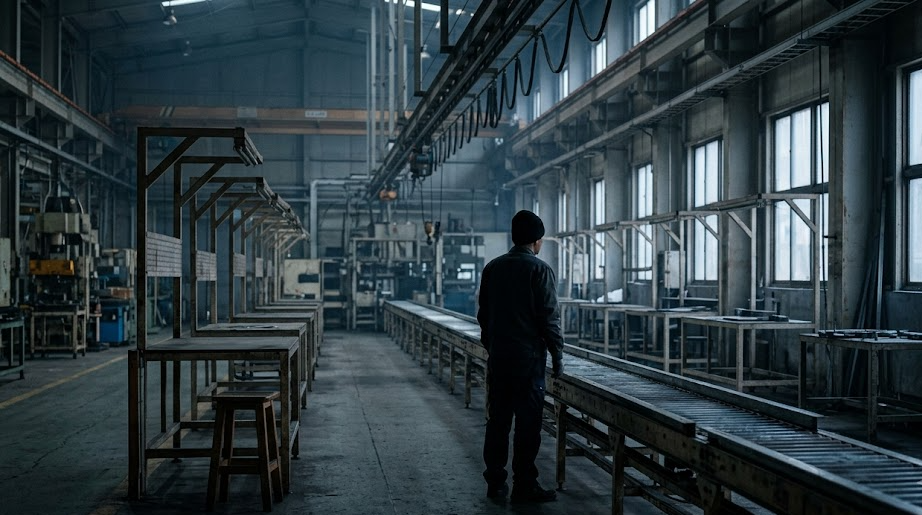
The Hyundai Motor, Kia and GM Korea branches of the Korean Metal Workers' Union under the Korean Confederation of Trade Unions held a press conference in front of Cheong Wa Dae in Jongno-gu, Seoul, on the 2nd and called for the formation of a labor-management-government council to respond to the spread of AI. After the press conference, the three branches delivered to Cheong Wa Dae a set of labor-government bargaining demands containing the formation of labor-government and labor-management-government councils to discuss domestic supply chains and job protection measures during the digital transition, and measures to maintain and expand domestic production of finished vehicles. It is a scene in which the debate over AI's impact on jobs has moved to the table of institutional negotiations.
The union did not take issue with dismissals. Park Sang-man, president of the Metal Workers' Union, argued that as capital concentrates its investment in automation, digitalization and AI, new hiring is not taking place even when vacancies open up and collective agreements are being rendered ineffective. The point is that employment shrinks through a method of not pushing people out and not filling empty jobs.
Studies abroad point to a similar place. The "Canaries in the Coal Mine" report released last November by the Stanford Digital Economy Lab found that in fields with high AI exposure such as software development and services, the number of workers aged 22-25 fell by an average of 16% compared with other occupations since the end of 2022. AI exposure refers to the degree to which a substantial part of a job can be handled by current technology. In the same analysis, employment held steady or grew for highly skilled experienced workers and for field occupations such as health aides, maintenance technicians and taxi drivers.
The Harvard report "Generative AI, a Technological Change That Favors Experienced Workers" analyzed the records of 62,000 workers and found that entry-level and experienced hiring rose together from 2015 to the middle of 2022. The point at which the two trends diverged was 2023. At companies that adopted AI, the number of workers starting their careers fell 9% over the six quarters after the first quarter of 2023, while hiring of experienced workers was largely unaffected. The two reports use different criteria and subjects, which makes direct comparison difficult, but they reach the same conclusion that the entrance to hiring is shrinking.
The domestic assessment is somewhat more cautious. Dr. Roh Se-ri of the Korea Labor Institute said in a keynote presentation at the APEC Future of Jobs Forum hosted by the Ministry of Employment and Labor that most Korean firms responded that AI replaces at most 10% of their work. Broad replacement has not been observed, but in occupations at high risk of AI exposure the adoption of generative AI has accelerated since 2023 and growth in youth employment is slowing, she explained. She added that across the OECD as a whole there is no explicit basis for concluding that AI's employment impact is negative.
Compared with past forecasts, the difference is clear. A survey of 21 AI and robotics experts from nine institutions including the Korea Employment Information Service, KAIST and Seoul National University projected that 15.75 million jobs would disappear within 10 years and that cleaners and kitchen assistants would vanish entirely. The side where declines actually appeared was not the cleaning or cooking occupations.

Entry-level positions in office and development jobs declined. The change came in the form of a narrowing entry route for a specific age group rather than a fall in the total number of jobs.
Behind the automaker unions' demand for a council are robot plans as well. Hyundai Motor unveiled the humanoid robot "Atlas" at CES in the United States in January this year, and its deployment on production lines at a U.S. plant in 2028 is under discussion. The AI-based unmanned factory concept "DF247" is mentioned alongside it. Lee Jong-cheol, head of the Hyundai Motor branch, said Hyundai's future plans contain only robots and automation with no respect for human beings, and called for discussion of job issues arising from industrial transition, job training, and employment measures for small businesses.
Lee said the employment crisis would hit simple sorting and assembly processes at small and mid-sized workplaces and subcontracted workers earliest. That is why the demands extended beyond job guarantees to support for job training and wage compensation during periods of job transition. An Gyu-baek, head of the GM Korea branch, said that if a single automaker is shaken, the livelihoods of hundreds of parts suppliers and hundreds of thousands of workers and their families collapse.
Nothing has been settled on whether the council will actually be formed. An official at the Korea Enterprises Federation said the matter has not been finalized, and since the Korean Confederation of Trade Unions is not participating in the Economic, Social and Labor Council, the framework in which the parties would sit down together also needs to be sorted out. The Ministry of Employment and Labor is gathering opinions from labor and management on a basic plan for employment stability related to industrial transition and is drawing up detailed tasks. Angelica, a senior adviser at the OECD, said in a keynote address at the forum that the government's basic plan must include monitoring of job impacts, social protection and an employment safety net.
In March 2016, Lee Se-dol 9-dan lost to AlphaGo 4 to 1. Ten years later, at the same venue, he gave voice instructions to an AI agent and built a Go app in 30 minutes, and in a game against the AI he had made he resigned after 61 moves. The distance between the person who handles the tool and the person pushed aside by the tool is contained in those two scenes. What is on the negotiating table now is the question of how to close that distance and who will pay the cost.