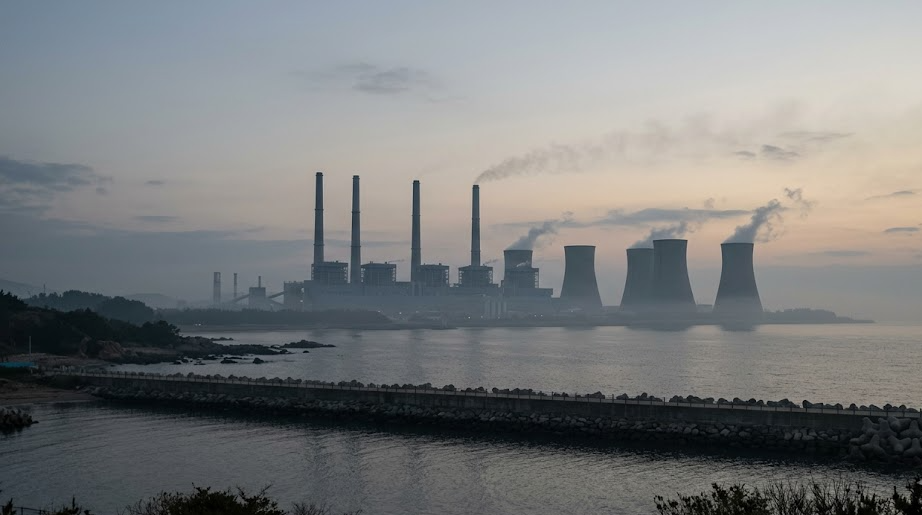
Aging generators whose output has been held below half capacity for decades will run at full power again. The Japanese government has decided to lift restrictions on the operation of aging coal-fired power plants temporarily for one year starting in April 2026. Behind the move is the sharp deterioration in conditions for procuring crude oil and LNG after the Strait of Hormuz was closed following US and Israeli attacks on Iran. It is a moment when the clock moving toward decarbonization has briefly stopped.
Japan has in principle held the utilization rate of inefficient coal-fired plants at or below 50 percent, encouraging equipment replacement and closure. This measure has the character of suspending that principle for a set period. The plants subject to the lifting of regulations amount to about 20 percent of all coal-fired power. Detailed plans are to be worked out through an advisory committee of the Ministry of Economy, Trade and Industry, and how far the operating cap will be relaxed will be decided through further discussion.
In numbers, the calculation is simple. Running the aging facilities at maximum output was analyzed as saving about 530,000 tons of LNG per year. That is equivalent to 13 percent of the roughly 4 million tons of Japanese LNG that comes in through Hormuz. It also means that in a country that relies on thermal power for about 70 percent of its electricity generation, the closing of a single strait immediately shakes power supply plans.
Where the fuel is bought from also explains this choice. Australia accounts for 74.8 percent of Japan's coal imports, Indonesia for 12.8 percent and Canada for 4.1 percent. These are routes that do not pass through the Middle East. Prime Minister Takaichi Sanae decided to expand coal operations after releasing national oil reserves, and both measures are focused on filling the immediate supply gap.
It is easy to jump to a convenient conclusion here. The story that when a crisis comes, countries go back to fossil fuels after all. But what this situation has revealed is closer to the fact on the opposite side. The more a country had staked its fuel supply on one particular strait, the more vulnerable it was to external shocks, and in trying to make up for that vulnerability it ended up increasing emissions.
Responses in other regions point to the same place. On March 13, ASEAN economic ministers agreed in a joint statement to accelerate the transition to renewable energy for regional energy security and resilience. In Europe, European Commission President Ursula von der Leyen sent a letter to member states on March 16. Solar, wind and storage require no import routes, which makes them security assets as well as tools for reducing emissions.
The fact that war itself increases emissions also cannot be overlooked. An estimate puts greenhouse gases generated in the two weeks after fighting began at 5.05 million tons. It is hard to state the range with certainty before the calculation method is disclosed, but it is clear that the costs of conflict are not measured in lives and oil prices alone.
The grace period given to Japan is one year. Whether those twelve months are used as time to reverse course into fossil fuel dependence or as time to build up a thicker renewable energy base will determine the character of this measure. Our own situation is no different. Checking the usage trend once on the electricity bill for a home or office, and adjusting the heating and cooling setting by one degree, are where a way of being less shaken by uncertainty beyond the strait begins.