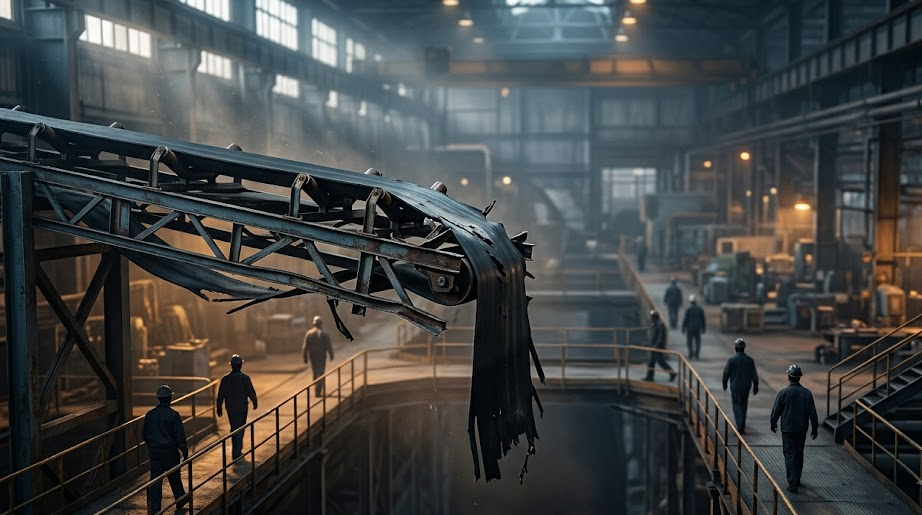
The story of a man who left his company at twenty-eight and went to learn welding no longer sounds like an unusual case. The sense that office job postings have shrunk reaches an individual's résumé before it shows up in the statistics. This is not a matter of asking why he left. The question to ask is where the mechanism was that would catch him after he left and move him to the next slot.
The government talks about redesigning jobs for the AI era. Redesign means there is a blueprint, and a blueprint has to draw both the slots that disappear and the slots that are newly created. Yet the discussion stays only on the slots that are newly created. How a person who stood in a disappearing slot holds out for several months and by what route they move on, the arrangements that fill that space are rarely to be seen.
The number of employed people in their late twenties has fallen noticeably, and at the same time a flow of that same generation toward skilled trades has appeared. These two scenes cannot be read separately. They mean that individuals set out to find their own exits before the system opened a path.
What is more urgent here than counting the jobs AI creates is building now a cushion that will catch the people pushed out of the jobs AI has cleared away.
The counterargument is clear and strong. Labor has always been changed by technology, and the market has in the end found a new balance. There is also real experience of automation creating more jobs than it eliminated. This counterargument cannot be brushed aside lightly.
Even so, this time is different in character. Past transitions ran across a generation, and people could buy the time to learn and to move. The present transition clears away first the tasks where new hires built their skills, such as drafting documents, organizing them, and first-line response. When the bottom rungs of the ladder disappear first, there is no way to climb even if a few new rungs appear above.
The cushion does not have to be grand. Income support that carries people through the living costs of a retraining period, short and dense courses that lead to credentials which work in practice, hiring practices that do not treat a career break as a flaw. When these three work together, a considerable part of the risk that individuals have been bearing moves to society. Right now a twenty-eight-year-old bears that risk alone.
The gaze that reads people in their twenties who moved into skilled trades as failures should also be withdrawn. Work that makes and repairs by hand is an area automation will find hard to replace wholesale for the time being, and that choice is rational. The problem lies in the fact that no path was prepared to support that move, so each person cut a side road of their own.
What has to change is not an individual's resolve. In a country where someone who has lost a job does not have to worry about rent during the six months of learning the next one, a transition does not feel like a fall. Then AI withdraws its force of pushing people out and becomes a tool that makes the day less draining.
That difference is not made by algorithms. It is made by how the system is designed.