The Financial Services Commission announced a roadmap to supply 790 trillion won in green and transition finance. The amount was specified, though whether this figure is on a cumulative or an annual basis, and over what period it will be supplied, were not presented along with it. The ratio in which policy financial institutions and private banks divide the supply has also yet to be finalized. The allocation ratio between green finance and transition finance was likewise not presented, so the share going directly into replacing high-carbon facilities and improving processes cannot be calculated for now.
Separately, the financial authorities released transition finance guidelines. The level to which reduction pathways and transition plans are required, and what sanctions follow when the standards are not met, fall outside the scope of what has been disclosed. If the eligibility standards are loose, the result may be existing loans given nothing more than a new name, and conversely, if the requirements are too tight, funds may flow only to projects that emit little carbon to begin with. The roadmap's effectiveness turns on where the line is drawn between these two extremes.
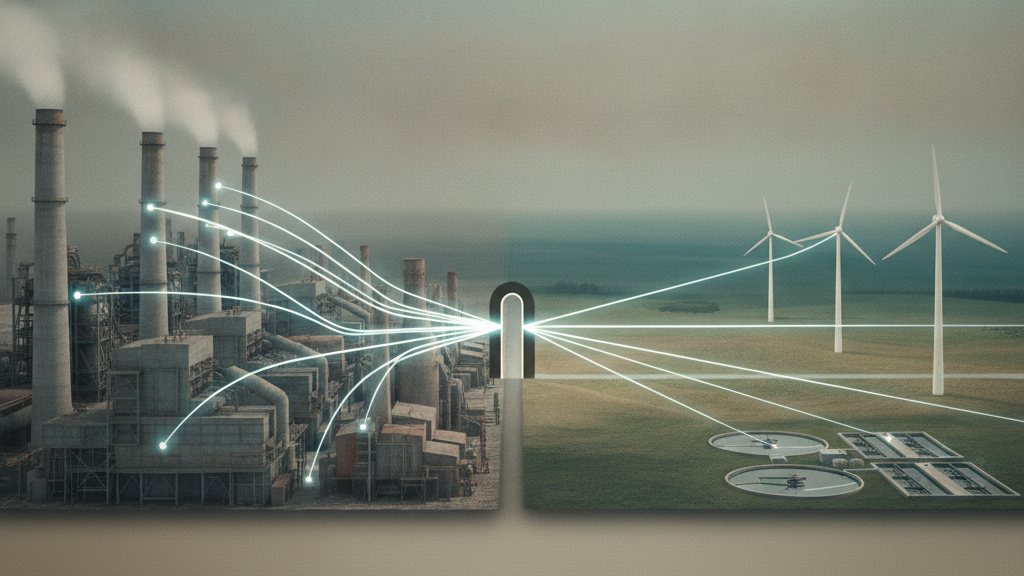
The banking sector's response will take shape from the second half of the year. IBK Industrial Bank of Korea (IBK기업은행) is understood to be planning to launch transition finance in the second half of 2026 in line with the release of the guidelines. The bank said it allocated the entire 150 billion won in green bonds it issued in 2025 to eco-friendly infrastructure projects such as wind power and sewage treatment. Quantitative indicators such as the total volume of transition and green finance support and the number of companies receiving it were not publicly available as of March 10.
The share held by the environmental sector in domestic sustainable finance remains small. The Korea Sustainability Investing Forum (한국사회책임투자포럼) put the share of environmental finance at 17% of the 2,012 trillion won in domestic ESG finance. The remaining 83% is in the social and governance areas or is money not classified as environmental. The supply target of 790 trillion won is close to a declaration that this share will be raised, and the actual extent of the shift is a matter to be confirmed at the execution stage.
On the 10th, the "2026 CDP Korea Conference" was held at the Ambassador Seoul Pullman Hotel in Seoul, hosted by the CDP Korea Committee (CDP한국위원회). At the event, attended by about 300 people, the research team of Kim Jong-dae, head of the SDG Research Institute at Inha University, presented the results of a six-year study of global financial institutions. It found that in an environment without regulation, fossil fuel investment appeared more advantageous in terms of corporate value and profitability. It is a finding that explains from the returns side why a transition left to voluntary action proceeds slowly.

A case in which regulation and the market moved together can be seen in an overseas bank's results. Standard Chartered's sustainable finance income in 2025 was $1.07 billion, up 9% from the previous year. By segment, banking rose 11% from a year earlier to $610 million, and capital markets and advisory rose 42% to $64 million. Transaction services came to $340 million and markets to $117 million.
Cumulative supply since 2021 stands at $157 billion, about 52% of the target of mobilizing $300 billion by 2030. Its own operational emissions fell 96%, from 148,000 tCO₂e in 2018 to 6,000 tCO₂e in 2025, achieving net zero on a Scope 1 and 2 basis. The bank earlier disclosed its first transition plan, presenting a net zero pathway across its financing activities by 2050. Cutting its own emissions and cutting financed emissions are tasks of differing difficulty, and progress on the latter is a part that will be judged by future disclosures.
External pressure works separately. With the EU's Carbon Border Adjustment Mechanism (CBAM) now in full operation, the costs to be paid by companies exporting emission-intensive items such as steel and aluminum have changed. Estimates of the burden by point in time for domestic exporters have not been finalized, and it is clear that demand for transition funds moves in line with the regulatory timetable. Whether 790 trillion won can absorb this demand can be assessed once the allocation criteria are out.
What period the 790 trillion won was tallied over and how the supplying entities are composed, how much is allocated to green and to transition, and what the guidelines' eligibility requirements are, are the items to be confirmed. When IBK puts out its product in the second half, a first real-world case will emerge in the interest rate terms and the requirements for eligible companies. The distance between the total in the policy document and the number of cases actually approved at the lending window can be measured from that point.