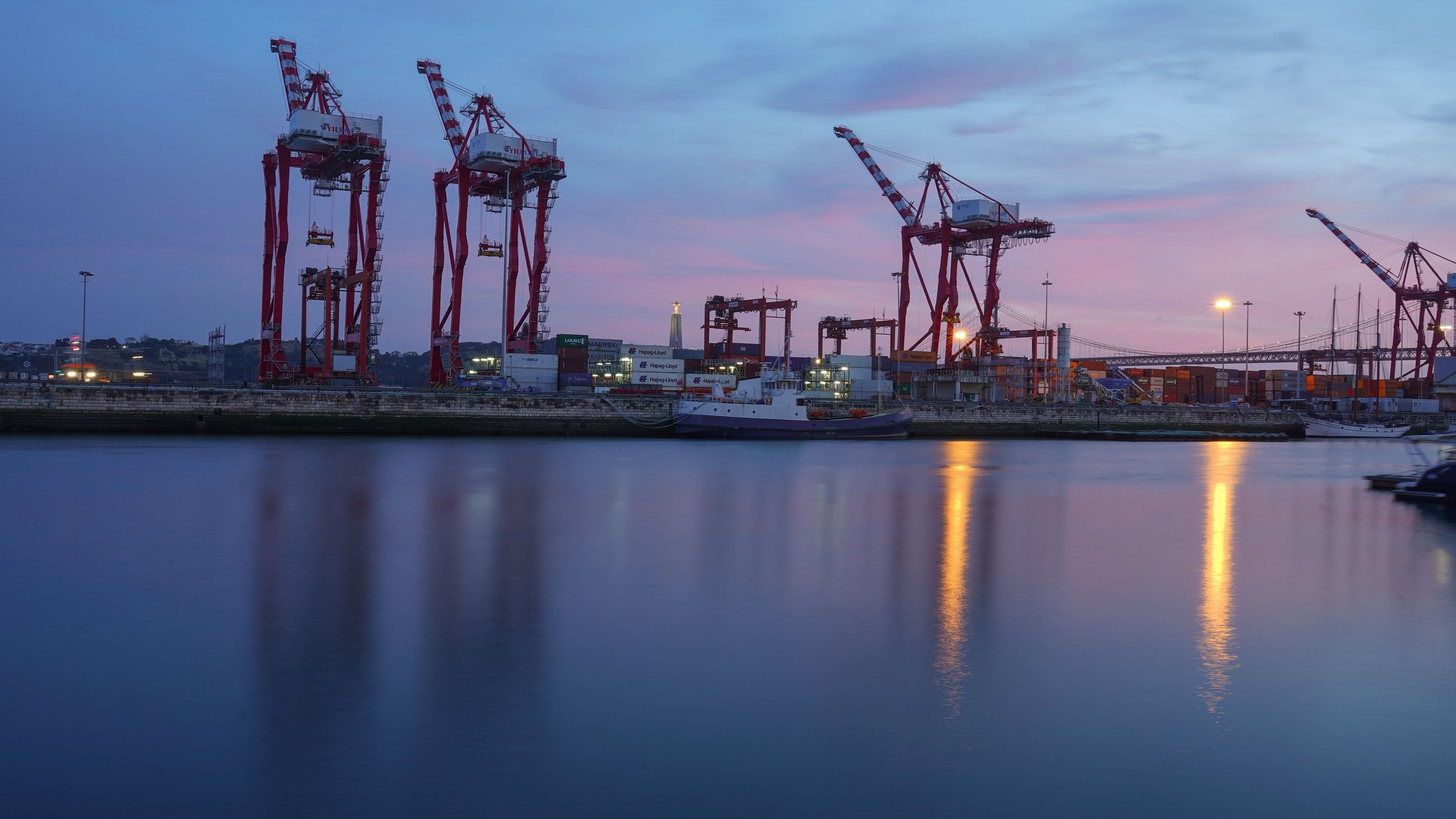
It is the short stretch of time after the sun has gone down. The sky spreads from navy to pink, top to bottom, and four red gantry cranes stand against that color like silhouettes. The cranes are all at a standstill with their arms raised, and behind the wharf, green and red containers are stacked like a low wall.
The surface of the water hardly moves. Where the long exposure has erased the ripples, only the streetlights come down in long orange bands. A small tugboat moored at the front of the wharf, and the lights on a bridge in the distance, tell us that this place is not entirely asleep.
A port is the phase where trade actually takes on a body. Numbers on a contract become steel boxes here, and the speed at which the boxes are loaded onto ships tells which industry is selling right now. The time the cranes spend halted with their arms up is not time when the flow has been cut off. It is the interval until the next unloading.
The height of a container yard is also the distance between demand and inventory. If more comes in than goes out, the wall grows higher, and if the reverse, it grows lower. A port is therefore a place that can already be read with the eye before the economic indicators are released.
What has the deepest color in this photograph is the cranes rather than the sky. The red steel is a color painted for the labor of the day, and now only that color remains, marking a position in the dark. Look once more at the cranes' shadows reflected on the water, and the halted side and the swaying side hold different shapes.