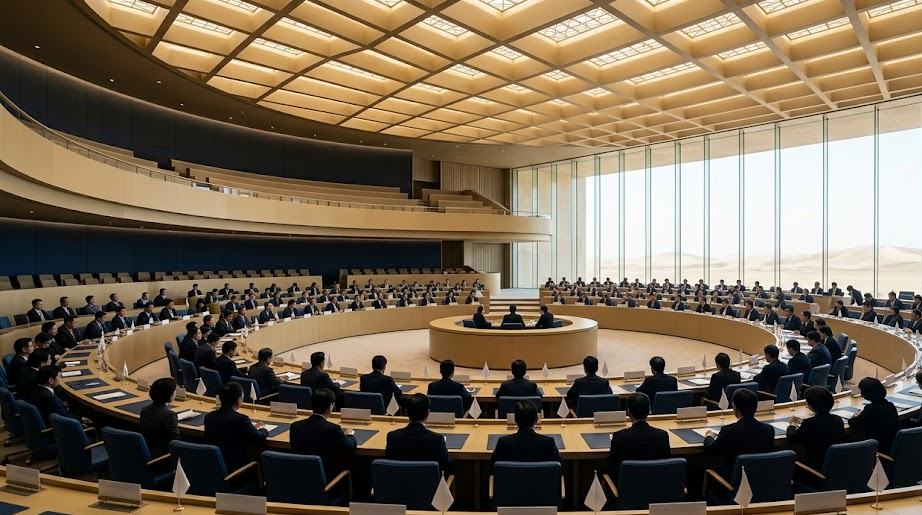
In the Abu Dhabi conference hall where 171 member countries gathered, South Korea's name was called as the next president. It was a decision made at the 16th Assembly of the International Renewable Energy Agency (IRENA), held on the 11th-12th, and the Ministry of Climate, Energy and Environment and the Ministry of Foreign Affairs announced it on the 13th. It is the first time South Korea has held the presidency. It has taken part as a Council member since around the agency's founding, but it had never stood in the position of chairing the assembly.
IRENA, which opened in 2011, is an international organization that deals with the development of renewable energy and the expansion of its supply. The assembly is held once a year and decides the main agenda items. The presidency runs for the single year of 2027, and on top of chairing the meeting it comes with the role of drawing up the agenda and leading cooperation between countries.
Lee Won-ju, head of the Energy Transition Policy Office at the Ministry of Climate, Energy and Environment, who served as chief delegate, explained the nomination as the result of international agreement being confirmed on a renewable-centered transition policy. From the Ministry of Foreign Affairs, Cho Kye-yeon, deputy director general of the Climate and Environmental Change Diplomacy Bureau, attended as alternate chief delegate. The government's preparation plan for assuming the presidency has not been released.
The badge is on, so now it is time to receive the report card. The government's "100GW of renewable energy by 2030" is a target that can only be reached by growing capacity, which stood at about 30GW as of 2023, more than threefold. The problem is the time it takes to hook a finished plant up to the power grid, more than the work of putting the plant up.
In 2024, the Korea Electric Power Corporation grouped 205 substations nationwide as grid-management substations, citing a lack of grid capacity. In Honam and Jeju, every substation in the region went onto the list. In these areas, connecting new renewable energy facilities to the grid is in principle blocked until 2031, when the transmission and substation facilities are completed.
The wall of time is no small matter either. Laying a single 345kV transmission line takes nine years on average, and more than half of the transmission and substation projects that have passed the planning stage are at a standstill over resident opposition and permitting problems. The government said it would cut the procedures through the special act on expanding the national backbone power grid.
There is another route. 99% of domestic renewable energy facilities are smaller than 10MW, and most of them are tied to distribution networks instead of transmission networks. That is why an approach that runs supply and demand at the regional level is realistic. In the case of Paju, Gyeonggi Province, a local PPA led by the local government is helping small and medium-sized companies use renewable energy at a lower price than private PPAs or KEPCO rates.
A power market reform report released by Solutions for Our Climate on the 12th points to this same spot. The current direct PPA has minimum facility capacity and contracted power requirements, which makes it hard for small operators and consumers to come in. Lowering the threshold can be decided far more quickly than putting up a transmission tower.
How South Korea is introduced at the 2027 assembly hall will be decided by the capacity connected over the next two years, more than by the statement read out that day. It is worth looking up the energy ordinances of the area you live in and the status of local PPA efforts on your local government's website. Whether Paju's case remains only a special success story or becomes the default in many cities depends on the size of that interest.