
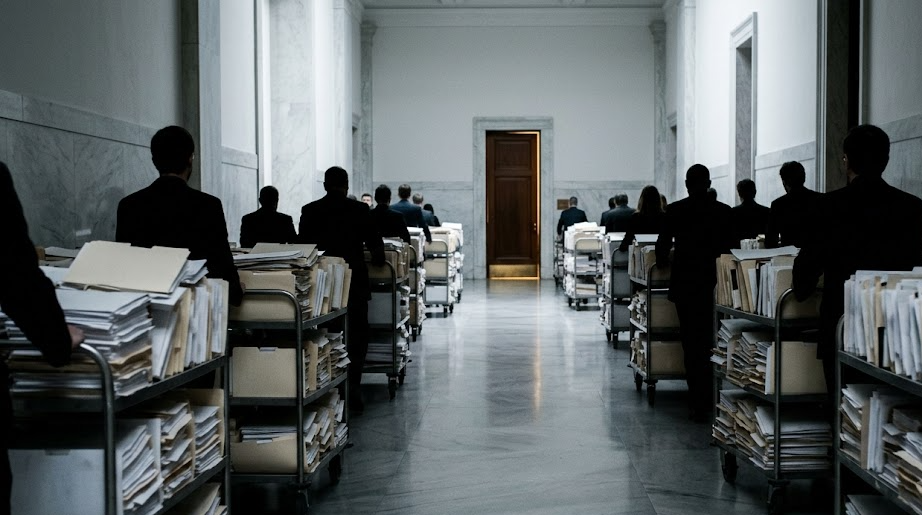
The lobbying money OpenAI spent on the U.S. federal government in the first half of 2026 was $2.22 million, about 3.25 billion won. That is close to double the figure for the same period a year earlier. Anthropic spent $3.53 million, about 5.17 billion won, and its increase reached threefold. Google and Microsoft also put more money into Washington than in any quarter since 2020.
What that money is meant to buy is written in the lobbying issue filings. The item the industry has the most riding on is the rule setting what review the U.S. government will require when a new AI model is released. The procedures for building data centers and the terms for connecting power to those facilities are on the list as well. Whether companies will be forced to disclose a model's parameters, the set of numbers inside a model that are fixed through training, is also among the contested points.
Blocking regulation is not the only aim.
Amba Kak, co-executive director of the AI Now Institute, read this spending as a move that carries both resistance to regulation and demands for industry support. An attempt by Congress to ban state-level AI regulation outright fell through, and the approach President Trump pushed through an executive order produced no result, according to Kak. The Trump administration, which has backed a loose federal regulatory framework, has held to the position that innovation is blocked when rules differ from state to state.
The companies also moved through signatures. Seventy-seven AI companies and investment firms, including Microsoft, Nvidia, Meta, OpenAI and Google, sent an open letter to U.S. policymakers asking them not to squeeze open-source models too tightly. About 25 places had put their names on it at the start, and the list tripled as OpenAI and Google joined. Nvidia chief executive Jensen Huang shared the letter on X and wrote that both cutting-edge closed models and cutting-edge open models are needed.

Legislation on the other side is moving too. In the U.S. Congress, prompted by a cyberattack aimed at OpenAI's GPT models, a bill has been introduced to require a "kill switch" that forcibly halts the operation of high-risk AI models. Little has been made public about how far the review has gone.
The enforcement decree of the Framework Act on the Development of Artificial Intelligence and Establishment of a Basis for Trust took effect on July 21. It requires state agencies to give priority consideration to AI products and services when buying goods or ordering services, and it creates a new system under which the minister of science and ICT confirms whether AI was actually used in a given product. The requirements and approval procedures for universities, companies and government-funded research institutes setting up artificial intelligence research centers are also written into the provisions.
The clause users will feel right away is the disclosure duty. A business running a product or service with generative AI must give notice in advance that AI is at work. Cases where anyone can see it is AI, and internal business use, were left as exceptions. A procedure was also set up through which a business can have it confirmed whether its own product falls under "high-impact AI."
Citibank said it operates a global oversight system in which 630 agentic AIs are registered and monitored. Shinhan Bank also presented cases of adoption. The second Singularity Finance Society (SFS) forum where the two presentations were made was held on July 20 at Douzone Eulji Tower in Jung-gu, Seoul. Among the participants there were complaints that domestic financial firms face tighter regulation than financial firms abroad.
Which models undergo which tests before release, whether an obligation to disclose parameters arises, and at what point a consultation in a banking app is handed over to a person are being decided through separate procedures in Washington and Sejong.