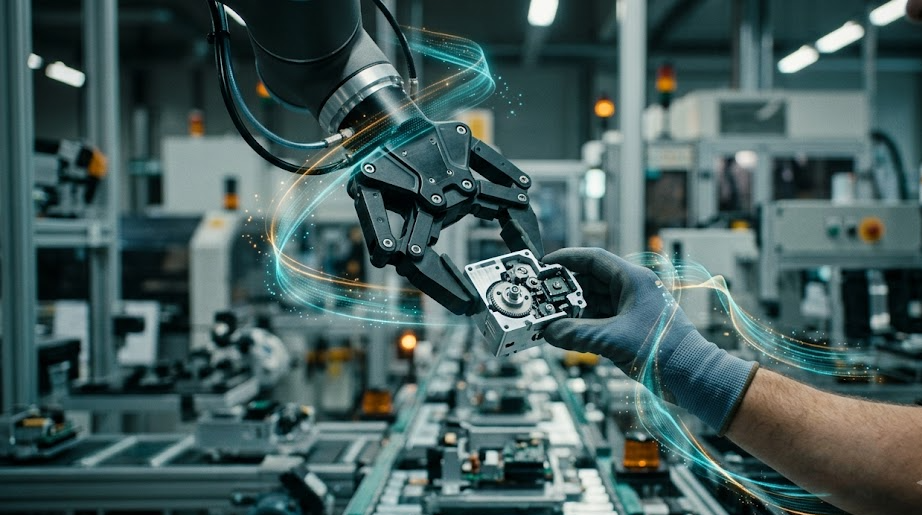
Samsung said on the 3rd that it will invest about 60 trillion won to make the Yeongnam region a "global physical AI innovation cluster." At a public briefing held at Gyeongsang National University in Jinju, Roh Tae-moon, president and CEO of Samsung Electronics (head of the DX Division), read out the plan himself. The money is split among four places, Gumi, Ulsan, Busan and Geoje. Samsung said it will create 200,000 quality jobs there.
The breakdown by base shows the character of this investment. It is 19 trillion won for Gumi, 16 trillion won for Ulsan, 15 trillion won for Busan and 10 trillion won for Geoje. Adding the four together matches the announced total.
In Gumi, Samsung Electronics and Samsung SDS will take on a humanoid mass production system, a robot data factory, an "AI-driven factory" based on manufacturing AX, and AI data center infrastructure. It is a plan to build a factory that makes robots and a factory where robots work at the same time. The other three places will take on parts and materials.
In Ulsan, Samsung SDI said it will mass-produce all-solid-state batteries for the first time in the world. All-solid-state batteries replace the liquid electrolyte with a solid, reducing the risk of fire and holding more electricity in the same volume. They are used in humanoids and electric vehicles. Lines for LFP and sodium batteries for ESS will also be expanded.
In Busan, Samsung Electro-Mechanics will make package substrates for AI servers and a mother line for high-value MLCCs. An MLCC is a component the size of a grain of rice that briefly holds electricity inside an electronic device and lets it flow out, smoothing the signal. In Geoje, Samsung Heavy Industries will build a base for constructing cutting-edge high-value ships and offshore infrastructure, and will push an autonomous shipyard based on 3X, which ties together the digital, AI and robot transitions.
Roh asked the government to designate a robot industry specialized complex and provide incentives, and to expand government-led projects related to the domestic shipbuilding industry. The view he stated was this. AI is turning traditional manufacturing plants into AI-driven factories centered on humanoid robots.
Robot operation and maintenance, work handling the data that teaches robots their movements, and AI engineering are newly created jobs. Jobs in which repetitive motion is the core, such as assembly and inspection, are the area robots replace. It did not disclose how it counted direct hires, suppliers and indirectly induced employment separately.
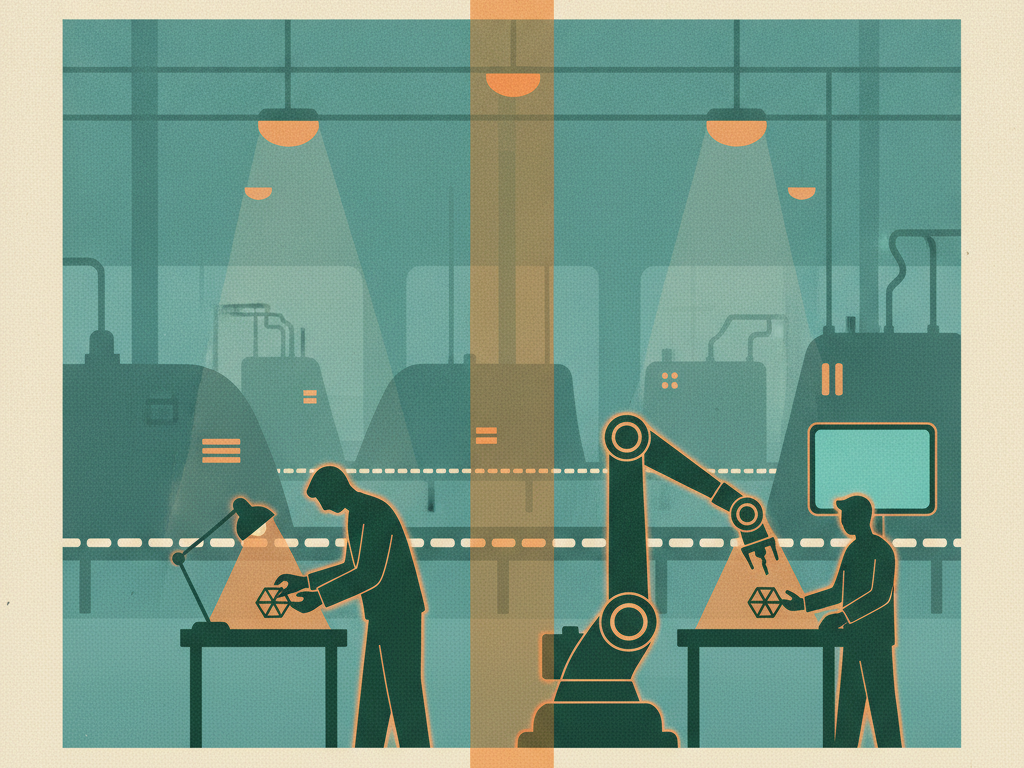
The AI transition on the manufacturing floor is not a matter for large companies alone. The Ministry of SMEs and Startups held a kickoff meeting for the "multi-AI agent demonstration project specialized for small and medium manufacturing" at the Pulmuone Foods plant in Eumseong, North Chungcheong Province, on the 29th of last month, and began field demonstrations of 12 tasks. Unlike existing smart factories, which stopped at running equipment automatically and gathering data, several AIs divide the roles among themselves to analyze processes, predict quality and assist the decisions of workers and managers. In food, Aizera will verify a quality deviation analysis and advance risk prediction model with Pulmuone Foods, and in beauty, Kairos Lab will verify application across the full cycle, from formulation design to regulatory review and clinical efficacy prediction.
The common difficulties the companies cited at the meeting were quality deviation, adjustment of process conditions, and a shortage of skilled workers. Quality deviation and the adjustment of process conditions are areas that have been covered by the feel of skilled workers, and the number of people to inherit that feel has fallen. The six-month demonstration will look at whether AI agents can fill this gap with actual data.
The same trend is under way on a larger scale outside the country. According to a report issued by the International Federation of Robotics on April 8, China's manufacturing robot density in 2024 was 166 units per 10,000 workers, up 17% in a year, and about 2 million industrial robots were in operation, 4.5 times as many as second-place Japan. Last year China installed more industrial robots than the rest of the world combined. Most of the world's humanoid robots also come out of China.
Behind this lies population. United Nations statistics project that China's working-age population aged 15-64, after peaking at about 1 billion, will fall to 300 million by 2100. The share of those aged 60 and over will pass half by 2100, from 23% now. It is a choice to fill with robots a future in which people cannot be found.
Yet in the same country, the unemployment rate for those aged 16-24 in May was 15.6%, up 0.7 percentage point from a year earlier. The population making a living from platform work such as ride-hailing and food delivery is more than 200 million. The Huazhu Group said automation had brought its staff-per-room ratio down to 0.1, while the industry average is 0.3-0.8. If the point at which jobs disappear comes sooner than the point at which the population shrinks, people bear that gap.
China's Shani truck plant has handed panel pressing and painting to robots, and is pushing automation and the introduction of humanoids even into final assembly, which takes the most human hands. UBTech released the U1 series of bipedal walking robots aimed at household support and emotional interaction in Shenzhen on the 30th of last month. The thicker the labor process data accumulated in factories becomes, the more precise the movements of AI with a body become. The Gumi plan also includes a robot data factory.
If things go as Samsung's plan says, jobs on the Gumi line move from parts assembly to robot operation and error checking. Whether the people who will do that work are the people standing on the line now, or new workers with different education and careers, has not been disclosed. Whether retraining and reassignment are dealt with together when the specialized complex and incentives Samsung asked the government for are discussed will decide the substance of the 200,000-job promise.