

The number of employed people rose in other age groups, and fell only among the young. Over the same period the employment rate of vocational high school graduates dropped to 55.2%, the lowest in the past five years, and the college enrollment rate was 49.2%, the highest since the statistics began in 2020. The government, citing job changes brought by the spread of AI and robots, is preparing a pilot basic income program for young people next year. Indicators from different places point to the same place.
Vocational high schools are a passage into the labor market straight after finishing high school. In that passage, the share of students choosing further study over employment passed 45% in 2021 and has risen every year since. By school type the gap is wide: 73.1% at Meister high schools, 52.4% at specialized vocational high schools and 38.2% in vocational tracks at general high schools. The tier attached to a school's name now carries over directly into the odds of getting a first job.
The fall in the employment rate is hard to explain by AI alone. Alongside the introduction of automated equipment, the reduction of government support for companies that hire high school graduates is also cited as a cause. The two factors push each other along. When routine work moves to machines and the incentive to hire entry-level staff weakens at the same time, companies lose any reason to teach people from the beginning.
Education authorities have begun to respond. The North Chungcheong Provincial Office of Education this month started running a "smart employment support team" of about 40 teachers and experts to help vocational high school students prepare for work. The South Jeolla Provincial Office of Education plans to revise its curriculum to match regional strategic industries such as AI, energy and batteries.
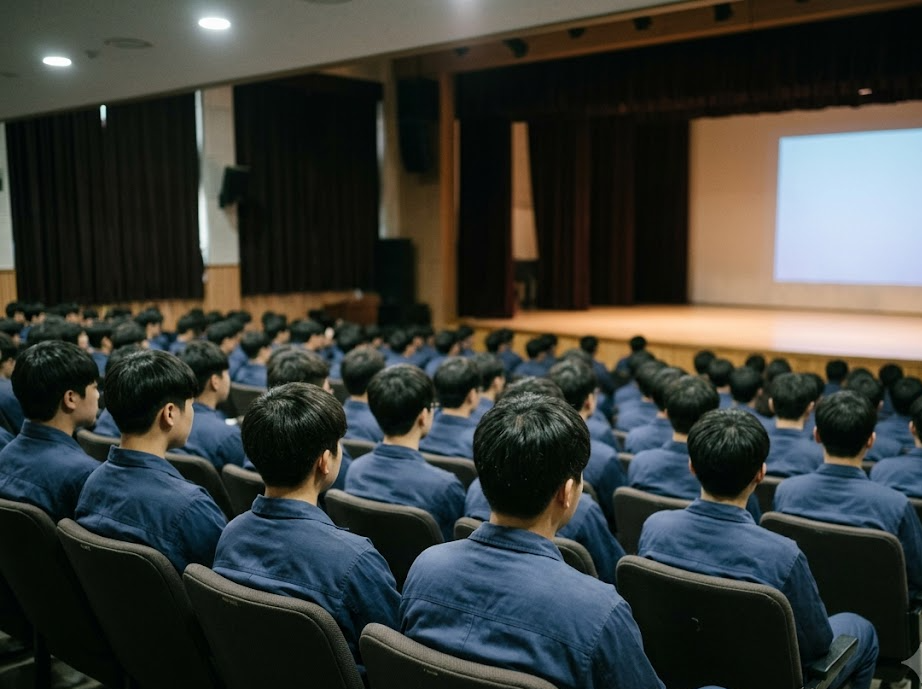
On the 1st of this month, at Seongdong Technical High School in Jung-gu, Seoul, the Seoul Metropolitan Office of Education and the Korean-German Chamber of Commerce and Industry held their first joint Ausbildung recruitment briefing, and about 80 students sat through three hours. Ausbildung is a German vocational education system that combines school classes with in-company training.
The signals from industry are more complicated. A survey run by the Nexon chapter of the Chemical, Textile and Food Workers' Union (화섬식품노조) at eight game companies belonging to the IT union alliance from the 27th of last month to the 10th of this month drew 1,078 responses, 65.9% of them from development roles. Only 26.7% said official discussions on AI adoption were under way at the company or union level.
By contrast, 82.3% said standards were needed for how to share the profits AI creates. Those who said they knew the flow of policy and industry in concrete terms stayed in the range of 10-16%.
Workforce adjustments in the same industry are not small in scale. Krafton saw about 271 employees leave as of January this year, and about 40 billion won was booked for a voluntary resignation program paying up to 36 months of salary. At Neople, a Nexon subsidiary, a development organization of about 100 people was reassigned after the weak commercial performance of "The First Berserker: Khazan."
In both cases, large-scale hiring during the high-growth period after COVID-19 and a slowdown in profitability are cited together as the background. No evidence was presented that AI was a direct cause.
Within the government, too, the diagnosis is not settled. Kwon Chang-jun, Vice Minister of Employment and Labor, said in an interview at the Seoul Regional Employment and Labor Office on the 10th that the spread of AI is hard to view as a simple loss of jobs and should be seen as a matter of job restructuring. He added that the shock of industrial transition could appear earliest among platform workers and freelancers, young people and small and medium-sized companies. That has a different tone from Park Hong-keun, Minister of Planning and Budget, who cited job losses from AI and robot innovation and a K-shaped recovery as the background for pursuing basic income.
The Ministry of Employment and Labor is pushing support for job transition and employment stability in response to AI adoption together with legislation to protect platform workers and freelancers, and is also reviewing project-based job training that uses large companies' infrastructure. It plans to concentrate on AI-related labor legislation in the second half of the year. The same topic was taken up at a meeting held on the 14th by the Democratic Party of Korea's special committee on games on industrial competitiveness and labor stability during the AI transition. Kim Hyun-kyu, senior vice president of the Korea Mobile Game Association, chaired the session.
No one can count exactly how many people technology adoption removes. But it is clear that the more the first tasks companies used to give new hires-organizing materials, writing drafts, simple coding-are automated, the more the stretch where people grow while learning disappears. Without that stretch, where are experienced workers made.
The government's basic plan for employment stability is due in June. Nothing has been decided so far on the target age and payment amount of the youth basic income pilot. What the students sitting in the Seongdong Technical High School auditorium wanted to know is probably not the name of a program.
It is where the door they are to enter stands. Whether the June plan states the location of that door will be the real report card for this policy.