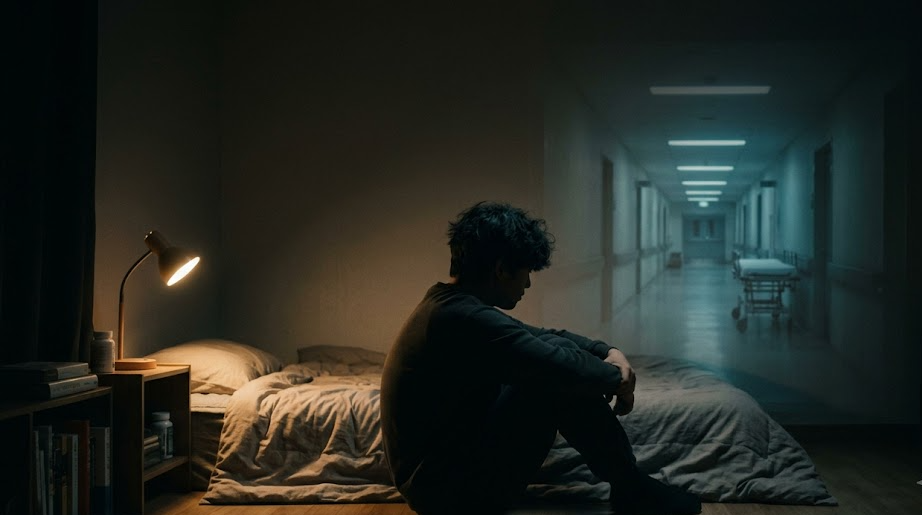
A child closes a bedroom door at midnight. What happens inside that room is not captured in real time by any statistic. On the day this child arrives at a hospital, only then do we record the child as a single case. But who guarded the time before that arrival.
The government announced that the state would take direct responsibility for mental health, presenting a full-cycle safety net that increases hospital beds and expands medical cost support. In the same week, survey results also showed that the leading cause of youth self-harm is emotional injury. The two pieces of news came in the same week, but they are aimed at different points in time. One supports what comes after a collapse, the other points to what comes before one.
Apart from the work of expanding treatment infrastructure, unless the capacity to hold on to the weeks and months of daily life before a child hurts themselves grows alongside it, the safety net becomes a house that has only widened its back door.
The counterargument is strong. There are people who cannot find anywhere to go because there are no beds, and who put off care because they fear the cost. Whether there is a place that will take you in an emergency is a condition that decides life and death, and speaking of prevention without solving this problem sounds like a luxury. There is no reason to delay expanding infrastructure.
Even so, the fact that emotional injury was named the leading cause cannot be passed over lightly. Emotional injury is not the kind of thing that can be sutured in an emergency room. It arises in relationships, and it recovers only in relationships. Beds save lives, but if the classroom and the home the surviving child returns to remain unchanged, the same road opens again.
The way of seeing that portrays those involved only as people in need of help must also be examined. Many of the children who chose self-harm are people who have passed through a stretch of time spent trying somehow to endure. What they need is the experience of having someone beside them who speaks to them before they collapse, more than the experience of becoming a subject of management. The more systems multiply, the more that difference decides success or failure.
So when looking at the new policy, the number of beds is not the only thing to check. It must also be written down who can open that door, from when, and through what procedure. The same goes for whether the design includes a channel that children and families can reach without burden at the stage before a crisis. If that item is blank, the safety net is a mesh woven only halfway.
Some things are changing. The very fact that the view that attributed problems of the mind to individual weakness has shifted into a declaration that this is an area the state will take responsibility for is a starting point different from a few years ago. Now it is time to watch whether the scope of that responsibility reaches beyond the hospital threshold. What the child who closed the door tonight needs is a word of concern that arrives ahead of the emergency room.