
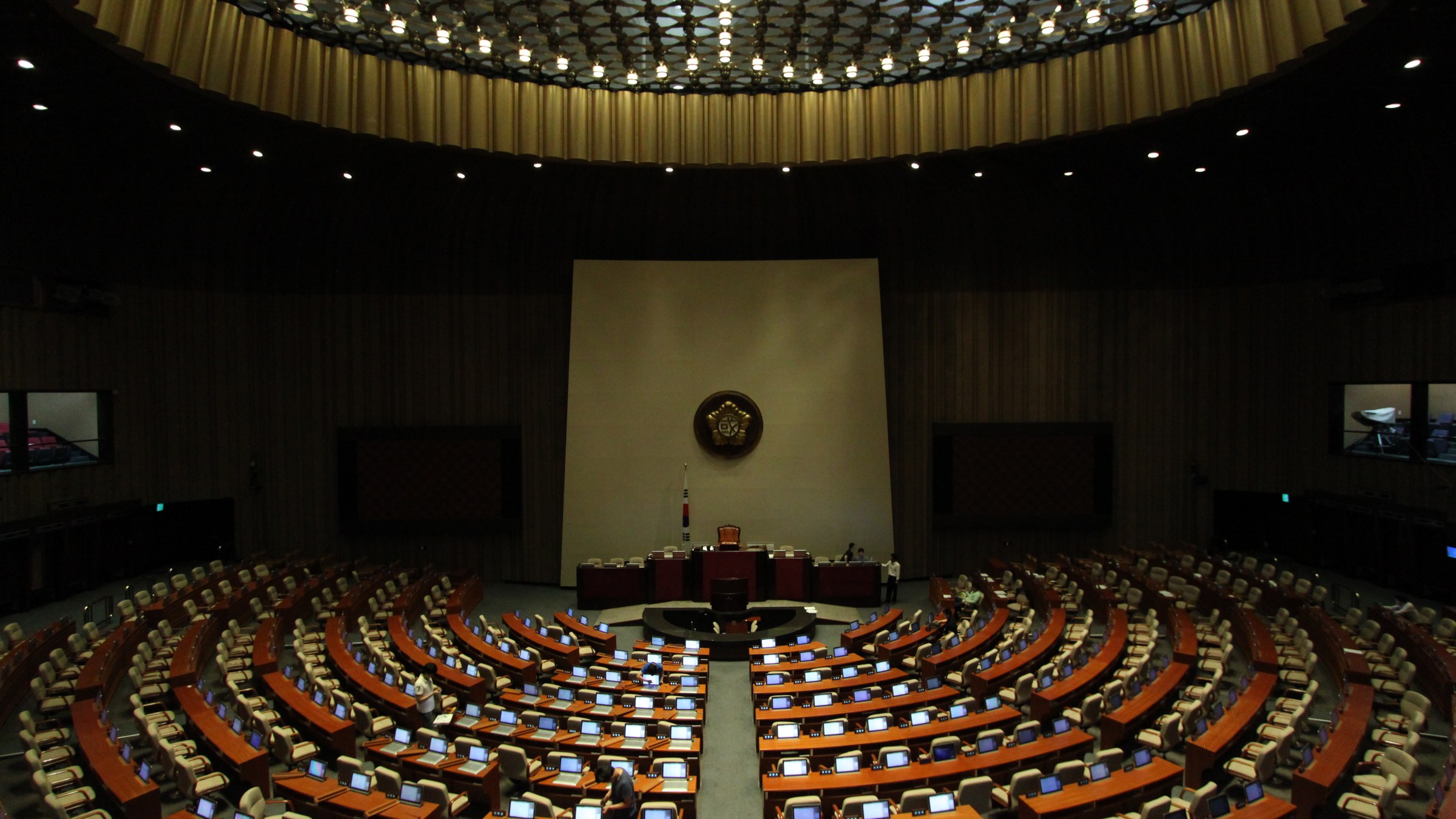
Everyone has had the experience of a date marked on the calendar passing without a sound. It is a different story when that date is a deadline the Constitutional Court gave the National Assembly, and what is at stake is the greenhouse gas reduction pathway from 2031 to 2049. The deadline for revising the Carbon Neutrality Framework Act has passed, and the law still has no provision covering that period. The legislative discussions opening in April are the phase in which that blank will be filled.
The Constitutional Court found it contrary to the Constitution that the law set a goal of carbon neutrality by 2050 while fixing the level of reductions after 2031 nowhere at all. The reasoning was that this is a design that pushes the burden onto future generations. The decision came with a revision deadline, and that deadline is now in the past. A state of having passed the deadline to fix a provision ruled unconstitutional reads, whatever circumstances are attached, as the National Assembly failing to do what it must.
So the core of the April discussions is what percentage of reductions is written into the law. Unless the amounts to be cut in 2035, 2040 and 2045 are fixed in statute, the next government and the one after it will again begin by rewriting the targets. The most expensive waste in climate policy is the time spent drawing up plans a third and fourth time, more than the reductions themselves.
The counterarguments are, of course, formidable. Industrial transition involves equipment replacement cycles and employment issues, and there is a worry that writing year-by-year figures into law removes any room to respond to economic swings or technological progress. In practice, the sectors that feel the reduction burden soonest are those with large process emissions such as steel and petrochemicals, and the anxiety of the people who work there is a matter of livelihood that cannot be brushed aside with political rhetoric. An amendment that treats this concern lightly will not last long even if it passes.
Yet it should also be seen that the absence of predictability is harsher on industry. What a company investing in equipment it will use for decades fears most is regulation that may change at an unknown time in an unknown way. Strict regulation itself is a secondary matter.
If a year-by-year pathway is in the law, companies can allocate capital accordingly, and workers can see in advance the timetable the transition requires. Setting reduction rates and supporting the transition cannot be traded against each other, and they should be contained together in one law.
Two ways of speaking are equally harmful in climate discussions. One is the resignation that it is too late whatever is done, and the other is the approach of hanging up a fine-sounding target while leaving the implementing provisions empty. The former makes people sit down, and the latter leaves no one accountable. Writing years and figures into law is the driest and surest way to slip between the two.
Assigning the responsibility for missing the deadline to any one person is easy but of little use. It is true that amendments have been discussed along several lines since the Constitutional Court decision, and there were certainly points where agreement was difficult. What matters is which bill is actually brought forward as statutory text in April, and whether that bill contains year-by-year figures for the period after 2031.
The point to watch is simple. Whether each amendment introduced states the reduction rates for 2035 and 2040 as percentages, or ends with "shall endeavor." Bill information from the National Assembly is open to anyone, and asking a district lawmaker's office which bill it supports is something anyone can do. The force that revives a law past its deadline comes in the end from the number of people who have read its text.